

Social, Financial, Political, Judicial, & Governmental Corruption in Uganda
The Context of Corruption in Uganda: Social, Financial, Political, Judicial, & Governmental. Links between and acquisition, bank fraud, money laundering, and social conflict.
Uganda is an origin, transit and destination country for human trafficking, primarily for forced labour and sexual exploitation. Most adult victims are subjected to domestic servitude or forced labour in various sectors, including agriculture, fishing, forestry, mining and street vending, and are often trafficked to the Middle East or other parts of East Africa. Fake recruitment agencies render migrants more vulnerable to human trafficking. Women and young girls are the most vulnerable to transnational trafficking, with many of them being fraudulently recruited for employment before being exploited through sex trafficking. Children in Uganda are also vulnerable, with child traffickers often subjecting them to prostitution and forced begging. Child traffickers are often individuals from transport or recruitment agencies, bar owners, rebels or strangers that steal children from their families. Traffickers also compel some children from the Democratic Republic of the Congo (DRC), Rwanda, Burundi, Kenya, Tanzania and South Sudan into forced agricultural and sex trafficking in Uganda. The financial struggles of care givers increased the vulnerability of children to human trafficking.
The easing of COVID-19 restrictions and free cross-border human flow (for both the criminals and victims) is fueling the crime. Uganda serves as a source, transit and, to a lesser extent, destination country for men, women and children. Human smuggling within Uganda is more prevalent than transnational smuggling and most victims are children. The country’s strategic location and high levels of state corruption make it a haven for smugglers, with many internationally wanted smugglers based in the country. While most labour migration recruitment agencies are legitimate and subject to government oversight, many cooperate with migrant smuggling networks and engage in document falsification, bribery or other criminal acts. Uganda is one of the largest refugee hosting nations in Africa and, with international borders opening, smuggling is increasing. Extortion and protection racketeering are also prevalent in Uganda. Outside of Kampala, gangs known as ‘iron bar gangs’, periodically extort businesses, residents and visitors. Although cases are widespread, most of them are not linked to organized crime. Despite the vast outplay of corruption, crime, fraud and violence that permeates Ugandan society, most of the police activity is spent repressing public protest of the endemic corruption that makes life impossibly difficult. The protest, partially inspired by recent youth-led protests in neighbouring Kenya, saw participation from young Ugandans who had mobilized online. The protesters’ demands include the resignation of Speaker of Parliament Anita Among, who had in February been named alongside other parliamentarians in a corruption exposé published on social media, and for the salaries of Ugandan parliamentarians, among the highest-paid in the world, to be reduced. In a statement posted on its X account on Friday, the U.S. embassy in Uganda urged the government of President Yoweri Museveni to investigate allegations that some of the detained protesters had been assaulted. The mostly youth led protests were met with overwhelming police and military force that broke up the small pockets of protest and arrested Several government MPs face corruption charges, with protesters calling on Parliament Speaker Anita Among to resign after she was implicated in a graft scandal – and sanctioned by the United Kingdom in June. Graft plaguing development programmes may be contributing to food shortage and malnutrition in north.

Land Fraud. Land-related disputes are the most common cases that are overwhelming the local courts in Uganda, both in rural and urban areas. The cases range from land grabbing, border disputes, encroachment on protected areas, disputes relating to compensation and family-related disputes like succession. Frustration and marginalization of tribal segments trying to adapt to the uncertainties of post-tribal urban life often result in violent conflict that is further complicated by population growth, government and legal corruption, government’s use of eminent domain for infrastructure development and changing land use patterns. As is the case in many developing countries, land registration in Uganda further adds to the conflict by unregulated land use agreements, land titles, poor record keeping, and government offices that operate with outdated systems, processes, and records. Practically and traditionally, there is a lack of transparency and accountability in the land sector with uneven and poorly managed mechanisms to resolve land disputes that pit the remnants of tribal councils against government officials who are susceptible to corrupting influences. Over the past several decades, the land ownership system in Uganda generally, and Kampala metro specifically, has allowed a cottage industry of land fraud that uses forgery, impersonation, and misrepresentation, to grow uncontained by government regulation. The population density of the Kampala Metro area helps explain the competition for land, space, and economic survival. The houses in any given local council area of Wakiso District ranges from large expansive home estates to one room structures with tin walls and roof and a dirt floor. As the government’s attention continues to be dominated by efforts to eliminate protests and civil disobedience against the Museveni regime, families all along the socioeconomic scale find themselves nervous about their land tenure, limiting their willingness to invest and build.
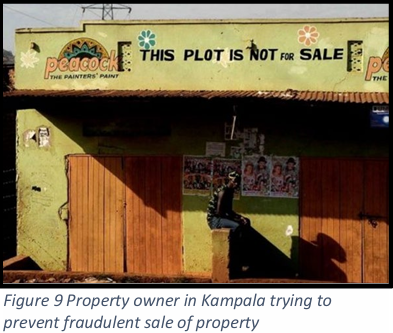
Most Ugandans report a deep distrust of the legal system of land ownership in Uganda and offer a mistrust of any system of justice afforded by the current government. The most vulnerable to Uganda’s corrupted land use and land title system are those without a historic tradition of land ownership, young people with no social support, widows, pastoralist, and elders, according to the Uganda Human Rights Commission, 2017.
By all accounts, conflicts over land are increasing and have dire consequences for the affected communities pushing Ugandans to take securitization of land into their own hands in the face of government corruption and incompetence.
Financial Banking Fraud. In the past 10-years, Uganda’s banking system has come under crippling pressure from fraudulent loans and money laundering schemes that are orchestrated by bank officials and facilitated by family members of protected government officials. Some of the banks involved thus far include the Centenary Rural Development Bank Limited, MTN Uganda, Tigo Rwanda, Stanbic Bank Uganda, Equity Bank Uganda, and others. The various criminal enterprises have taken billions of shillings out of the Ugandan economy that has left both national and international companies with large financial losses. At the same time, other criminal enterprises have injected up to USD $50B into the Ugandan economy that does not exist, through the employment of internally generated float, or created e-money, on the mobile money system. The ‘float’ would then be sent to colluding agents and customers who cashed out the value. This means that e-money was being generated that was not backed by physical cash in MTN’s bank account held at Stanbic. As one former MTN employee testified, the stolen money was essentially “printed by MTN itself”.
This demonstrates how fraud of this nature can have financial stability implications. The unauthorized internal generation of float led to massive discrepancies between the general ledger account (MTN’s e-money balance) and bank balance at Stanbic. At one point, audit reports revealed that the discrepancy totalled 146 billion UGX, roughly $50 million, in falsely created e-money. The audit reports, from as early as 2009, warned MTN of various weaknesses in the mobile money system that made it prone to fraud, such as the mismanagement of user rights administration. It was reported that terminated employees continued to have access to the system as their user rights remained active and their passwords unchanged. At Equity Bank, the managing director, the head of agency banking, the bank’s relationship managers, bankers, relationship officers, and distribution and marketing officials worked collaboratively with outside persons to steal hundreds of millions of Ugandan shillings from bank account holders and investors. While the schemes varied from bank to bank and group to group, a common thread was that loans were created for wholly fictitious persons, or for unsuspecting people meant to take criminal responsibility for the fraudulent loans. The criminal enterprises include fraudulent diversion and disbursement of funds from the bank, in form of unsecured loans to unqualified people. Some of these included relatives, with whom they created fictitious companies and fraudulently disbursed huge amounts of money, that would be picked directly by the staff or indirectly using co-conspirators, proxies or conduits. The investigations depict a brazen effort to siphon monies from the bank into personal accounts or accounts of family members. Another six employees of MTN Uganda were arrested and charged with defrauding and embezzlement of the company out of 10 billion USh ($3.4 million), including the company’s finance manager, director of public access-mobile money. Along with sensational daily headlines, this case is providing a detailed account of the impact of a particularly large and public internal fraud on the mobile money system.


Comments