

Country of Origin Report - Colombia
Regional & Country Psychosocial Profile - The (violent) Psychosocial Conditions of Life in Colombia

This is the story of a clash of civilisations that began more than 500 years ago with the Spanish conquest and colonialisation of the Andean Mountains and Amazonian Jungle Basin in South America. Unlike other parts of Mesoamerica, the density and resilience of the indigenous populations prevented the new ruling European social order from either absorbing them or eliminating them as co-inhabitants of those lands. For several centuries after the colonialisation was complete, the new and the old societies grew in numbers, while remaining separate in an uneasy coexistence. In the late 20th and early 21st centuries, this conflict has begun to re-erupt again driven by indigenous sociopolitical awakenings in one part of Colombia’s population and unstable large group identities on the other. This clash of civilisational identities is fuelled by discoveries and extractions of vast arrays of natural resources valuable to European-centric states in North America and Europe, but which often result in the degradation of national resources valuable to indigenous-centric societies within. I have been learning this story for most of my adult life and admittedly, it gets complicated at times, even frustrating. We find that simply to understand one part of a conflict narrative that involves a person, a family, a village, or a state, we have to consider so many different variables in play. For example, we cannot understand the leftist FARC or ELN organisations without understanding the right-wing armed militias and their interrelationship between the governments (local and national), the Eurocentric population, the indigenous population, and the mixed blood populations in between. The reason for this is that as the natural resource valuations increased dramatically, the population segments of all groups grew, leaving insufficient space to continue their historical uneasy co-existence. For the purposes of this country-of-origin report, we begin relatively recently, in the 1920’s, a period of social and economic expansion of urban technology, trade, travel, manufacturing, and resource extraction. This will be easier if you examine the graphic aid in figure 1, which overlays some of the armed violent groups contesting for control of the state, with oil pipelines, natural gas fields, major cities, and the mountain and jungle terrain. The graphic includes Ecuador and Peru in order to show that the three political states share common terrain, populations, and problems, albeit in different degrees and with differing conflict dynamics. These overlays are inextricably linked for the population segments, for the infrastructure development and destruction, and for the armed factions competing for control. The search for and extraction of petroleum, natural gas, emeralds, and gold played an important role in Colombia's GDP and foreign trade in the last 20 years. Violent contests over land titles in the resource fields and pipeline pathways led to massacres and the formation of oppositional self defense forces aligned with the political poles of the capital. The discoveries of natural resources and the rise of cocaine cash-crops drove changes in national policies in the capital cities of Bogota, Lima, and Quito. The struggle over natural resources and land brought these two population segments together into violent conflict that has lasted more than 100 years. These segments had previously ignored or tolerated each other during the first century of independence as a state. While the modern civil war in Columbia between the FARC-EP/ELN against the Eurocentric government has its overt roots in the intense struggle between communism and capitalism, the psychosocial, political, and economic motivations had deeper roots between rural indigenous and urban European cultures that represented a violent clash of race, identity, and subjugation.
§A1 Violent Contest Between Pre-Columbian and Colombian Civilisation
During Colombia’s first century of independence (~1820 to 1920) the basis for political identities coalesced around two poles: European versus Indigenous identity. Coalesced around the former were all citizens who were and or desired to be European, Caucasian, and/or Capitalist. Coalesced around the latter were all citizens who were not and did not desire to be European, Capitalist, or who supported a multicultural, multiracial, and multilingual body politic. Under this imperfect categorisation, economically successful mestizo families could and did align with the European colonial elite, while criollo politicians and Catholic priests could and did align with social-reform oriented movements that sought to transfer wealth and ownership to indigenous and mestizo farming populations. These two imperfect labels reflect the attitudes and worldviews of the bodies of their adherents which underly the political alignment and associated labels of conservative-right against liberal-left. In developed societies, these labels are associated with social policies, however in Colombia, Ecuador, and Peru, they are more often associated with ethnic and cultural identity.
The European identity pole was and is characterised by conservative Catholicism, loyalty to the state, egocentric families, free-market orientation, and acceptance of private ownership and exploitation of natural resources. §A2 below describes the outlines of this Eurocentric worldview in opposition to the electoral gravitational shift of the existing sociopolitical structure in Colombia, Peru, and Ecuador.
The Indigenous identity pole was and is characterised by mixtures of catholic-animism, tolerance to the state, sociocentric families, collectivised-market orientation, and belief in the public ownership and preservation of natural resources. It is called Quechua Pacha and, in its raw form, is unpalatable to the Eurocentric identity of Colombians, Ecuadorians, and Peruvians. §A3 below describes the outlines of this indigenous worldview in opposition to the existing sociopolitical structure in Colombia, Peru, and Ecuador.
The graphic pictorial map in figure 1 overlays Colombia’s terrain with its natural resources and the locations of the FARC-EP and ELN. At the height of their strength in 2007, the FARC had an estimated force of over 18,000 men and women under arms. The Andean Mountain ranges dominate the western half of the country, and the cities, valleys, and slopes therein are notably cooler in temperature than the Amazonian plains below. The significance of this is that most of the European colonial settlers clustered either in the cool highlands or along the coastal pacific regions, leaving the rich soiled farmlands with large rainfall to the indigenous and growing mestizo population segments. Most of Colombia’s petroleum and natural gas fields were also under those areas and the larger deposits of gold, emeralds, and nickel were often located under indigenous lands and or lands claimed by the mestizo peasants. The post-colonial European elites of Colombia, Ecuador, and Peru would normatively buy and sell lands under grants of colonial governance without regard to the indigenous or peasant populations within. Indigenous and mestizo peasant identity is fused with the land in a manner that is emotionally charged and a critical driver of violence. Legal titles to Vivienda and finca, home and farm, consume most of the conflict resolution energy of countering violent insurgents on both sides of the Euro-Indigenous identity poles. The discovery and extraction of natural resources underneath these tribal and private lands continues to fuel violence and the rise of self defense militias. Figure 1 illustrates the overlay of rural Colombian life with the location of its natural resources. During my years spent advising the Colombian Government and COLAR in its battles against the FARC and, to a lesser extent, the ELN, our focus was on winning the hearts and minds of the indigenous and mestizo peasant communities whose sons and daughters provided the labour and popular support that kept the revolutionary movement going. I found there to be a significant difference between our tasks to demobilise and dismantle the FARC-EP and the ELN. To be clear, the FARC and ELN revolutionary forces were (in varying degrees) against the European conceptualisation of life in Colombia. In opposition, the counter-revolutionary ideas of the right-wing paramilitaries involved the reinforcement of European, free-market, and Caucasian superiority. Between the beginning of my tour as a combat advisor in Colombia in early 2006 and the eventual peace treaty in June-August 2016 that formally disbanded the FARC-EP, our work resulted in the surrender or defection of tens of thousands of young men and women and their families from the ranks of the armed movement. After the Colombian parliament approved the peace agreement, the demobilised FARC families were resettled into newly built towns and farms as peaceful Colombians, while the FARC-EP transformed from a revolutionary army to a political party registered as COMUNES. Former leftist guerrilla members and leaders began running for public office after the peace accords and parliamentary approvals of reintegration of the demobilized guerrilla fighters. In 2022, a former guerrilla fighter Gustavo Petro, won the presidency of Colombia, with his running mate, Francia Márquez, is the first Afro-Colombian elected to the vice-presidency. The evolution of Colombia’s government from right-wing Euro-nationalist to multicultural, multi-ethnic, multi-lingual was decades long struggle. American Army Special Forces personnel would spend nearly their entire careers working to build trust with their Colombian counterparts as a precondition to turn their search-and-destroy orientations to one of winning hearts and minds through social action programs at all levels of government. The Special Warfare Journal article attached to this research report is part of the historical record of countering the FARC-EP, ELN, M19, and other leftist insurgent groups under the United States’ Plan Colombia over the last 30 years. The article illustrates the lengths to which Plan Colombia had to go to break the popular support for the FARC and related insurgencies and return Colombia’s rural departments to popularly elected governance. The efforts of Plan Colombia were both heralded and derided by both sides of the conflict but is essential to understanding the ongoing violence in Colombia even after the demobilization of the FARC-EP and ELN as leftist armed social movements. The warnings of our work in Colombia to undermine the appeal of the armed leftist guerrilla movements presented in the earliest days of our efforts, with stiff resistance from senior police and military officials in the various departments. Then president Uribe and his successor, Manuel Santos, provided us support with numerous personal visits and transferring control of our host nation partner, Acción Social, to the direct control of the office of the president. These and other initiatives helped to reinforce the authority of the elected governors whose base of electoral voters we were trying to wrestle away from the FARC. Doing so was easier said than done and in one case, the voters of the town of Puerto Rico, elected one of the active guerrilla leaders of the FARCs Teofilo Mobile Column. One of the most serious warning signs was in the areas of land reform, ownership, and titles, especially between individual families versus large corporations based in Bogota as described in the attached journal article. While the structural reforms were necessary to rebalance life in the rural areas as a means of undermining popular support for the FARC and ELN, an even greater warning sign was the conflict over the European versus Indigenous understanding of Colombian society. The pictures shown here in figures 4 and 5 illustrate the core of the social conflict in Colombia, as well as Ecuador, and Peru: post-colonial ethnic and cultural warfare.

Even more than the political labels of communism or fascism wielded by political opponents, cultural, ethnic, and historical identity is central to understanding the context of the growing conflicts in Colombia, Ecuador, Peru, and the Northern Triangle. Without this perspective of Latin American Eurocentric society’s resentment and resistance of indigenous and non-European identity, it is difficult to comprehend their subsequent resurgence after the leftist revolutionary military organisations were (mostly) dismantled.


During Plan Colombia, we made a concerted effort to have these types of white Eurocentric symbols removed to abide by the new Colombian draft constitution that President Uribe pushed into legislation – that the Republic of Colombia is a multicultural, multilingual, multiethnic, and multireligious nation. Many of the military and diplomatic team members of Plan Colombia carried around that early draft and subsequent iterations of Colombia’s constitution as we pushed back on notions of white, christian, European nationalism that hampered the sort of social rebalance necessary to end the 50-year insurgency. Only recently, these efforts have begun to be rolled back by the proponents of the Madrid Forum, or Foro Madrid, an international effort based in Spain’s right-wing conservative party, Vox. While neither Vox, nor Foro Madrid are responsible for the rise of right-wing paramilitary violence in Colombia, Peru, and Ecuador, the ideology emanating from these organisations provides the logic of violent action under the guise of protecting historical patrimonies of postcolonial power.

§A2 Latin America’s Post-Colonial struggle to remain European.
There exists a psychological pathology in several of Central and South America’s ruling social class of alienation from their preferred self and collective identities of masculinity, femininity, and patrimony. §5.3 below explores this pathology and the observable sequalae that my research team and I have been documenting over the past several decades. In the years after the FARC-EP demobilised and folded their thousands of ‘guerrilla families’ into towns and farms where they transitioned into civilian life, nearly all of us were surprised when one of their members successfully won the presidency. For segments of Colombia’s Eurocentric population however, the surprise was accompanied by feelings of betrayal and abandonment. They believed that they had “sacrificed for generations to put down the leftist ideology and now, voters had given them at the ballot box, what they had not been able to achieve on the battlefield”. Not all segments, but enough segments with sufficient corporate and political support to bring them into a resurgence. From their perspective, they had fought alongside Colombia’s Armed Forces to battle the forces of communism, socialism, and an indigenous transformation of Colombia’s society only for the political system to hand over to their enemies, the keys to the Republic. In the Madrid Forum, they found an anti-communist voice in the work of the Disenso Foundation, a think tank of the right-wing Spanish political party Vox, led by Santiago Abascal. The Forum’s founding document, the Madrid Charter, includes signatures by right-wing members of the Republican Party in the United States, Venezuelan opposition members, Cuban dissidents, Fujimorists of Peru, and other representatives of political parties from Latin America. The Madrid Charter was more of a manifesto calling for an international structure and detailed action plan. The Vox political party initially introduced the project to the government of former United States president Donald Trump while visiting the United States in February 2019, with Santiago Abascal using his good relations with the administration to build support within the Republican Party and establishing strong ties with core American supporters of Donald Trump’s populist movement.
§A2.1 The quest for Blanqueamiento and European identity: Cultural Pathologies of Alienation and Shame.

The population in the interrelated countries of Colombia, Ecuador, and Peru consist of segmented societies with vastly different psychological organization and sociological constructions. Each of these three countries share their physical spaces with the original pre-Columbian indigenous peoples of the Amazon Basin and the Andes Mountain Range as depicted above in figure 6.
Most of the political-military power, economic control, and national cultural expression rests with the small percentage of those who identify as (but not always are, by DNA) Caucasoid-European. The highest socioeconomic level of citizen in these three countries is called a ‘criollo’ or pure Caucasian-European descendant whose individual/family bloodlines can be publicly traced back to European bloodlines without the introduction of either Indigenous or Afro Latino DNA. Race, therefore, is mostly subjective and important only to those families who define themselves as European versus Indigenous. These two collectives exist at opposite ends of the psychosocial spectrum of society, are in direct opposition to each other, and each constitutes approximately a quarter of each countries’ total populations.

Often, our qualitative research discovers that those individuals and their families who are most vocally insistent that they are European-Caucasian are, by visible observation, from a mixed or mestizo heritage, albeit closer to European than indigenous in phenotype. These segments of mestizo populations are often extraordinarily sensitive to any suggestion that they may not be a part of the European-Caucasian ethnic group and may go to excessive lengths to deny their actual mestizo identity and engage in processes that deepen and secure their preferred membership as European-Caucasian or criollo identity phenotype. In each of these three countries, Racial/ethnic descent is highly politicised in the way it is reported. In Colombia, race and ethnicity are artificially grouped into three racial groups—Europeans, Amerindians, and Africans. The Colombian government attributes African ethnicity as distinctly African as observed in the participant’s phenotype. Amerindian’s are populations of recognised and (now) protected indigenous peoples of the Andes Mountain Rainges and Amazon Basin who self-identify as such. Colombian citizens who identify as neither recognised Afro-latino nor protected indigenous, are characterised by the census as being ‘Colombian of European descent’ and by the government’s count, constitute around 87% of its population. Social science demographers, however, describe Colombia as one of the most ethnically diverse countries in the Western Hemisphere and in the World, with 900 different ethnic groups. During qualitative and quantitative data collections, most Colombians identify themselves and others according to ancestry, physical appearance, and sociocultural status. Social relations reflect the importance attached to certain characteristics associated with a given racial group. Although these characteristics no longer accurately differentiate official social categories, they still contribute to one's rank in the social hierarchy. In 15 of Colombia’s most populated departments, social scientists have determined that the average Colombian (of all races) has a mixture of 47% Amerindian, 42% European, and 11% African. These proportions of ethnic reality vary widely within the various socioeconomic population segments and can actually be used to determine the likely sociopolitical attitudes of a given social segment. Population segments further from the seat of power in a given department or town tend to refuse to identify in self-characterisation of their own ethnicity outside of ‘Colombiano’ in an attempt to remain neutral. Population segments that are close to the seat of power in a given town that are distinctly indigenous or darlkly mestizo, however, are likely to embrace indigenous worldviews as described in §A3. Population segments that are close to the seat of power in a given department and city that are distinctly criollo or light-skinned mestizo, are likely to embrace European worldviews as described in §A2. In Colombia’s communities of criollo or light-skinned mestizo’s, European identity is based on ethnic purity as a measure of belonging combined with claimed lineage and family wealth which is preserved at all costs to ensure the family does not slide downward into indigenous categorization and out from European privilege. A study by Latinobarómetro in 2023 estimates that 50.3% of the population are Mestizo or around 26 million people, 26.4% are White, 9.5% are Indigenous or around 5 million people, 9.0% are Black, 4.4% are Mulatto, and 0.4% are Asian, however estimates of each vary between sources. Therefore, it can be estimated that 26 million people are Mestizos (being the largest population segment in the country), 14 million people are White (includes castizos and euro-descendants), 5 million people are Indigenous, 5 million people are Black (excluding mulattos), 2 million people are Mulatto, and 200 thousand people are Asian. Indeed, Colombia is an ethnically and linguistically diverse nation. The various groups exist in differing concentrations throughout the nation, in a pattern that to some extent goes back to colonial origins. The new Colombian government under the liberal presidency of Gustavo Petro and his VP Francia Márquez, has begun to enforce laws that protect indigenous and Afro-Colombians, challenging the centuries long preferential status of Colombia’s European Caucasian elite. This is where race-ethnicity become political constructions of identity rather than mundane census statistics. Returning to figure 6, the balance of sociopolitical power rests within the 50.3% majority of the Mestizo population. But this population is NOT a uniform block of ethnicity, but one of graduating degrees of phenotype and psychosocial cultural identity. The lighter a Mestizo’s skin colour, the more that he/she is expected to support the white/criollo/Eurocentric elites that control much of the socioeconomic activity in Colombia. The darker a Mestizo’s skin colour, the more likely he/she is to be treated as part of the indigenous and Afro-Latino landscape that must be controlled and managed through political and coercive power. The absurdity of this violent situation is that indigenous and Afro-Latino phenotypes are not perfect indicators of cultural identity. The darker one’s skin and the more one’s facial features reflect one of the typologies of indigenous (versus criollo) phenotypes as shown in Figure 7, the more likely one is to be excluded from consideration as belonging to the power-holding Spanish culture.

This racial-cultural dynamic illustrated in figure 8 is a social, political, and economic practice of Blanqueamiento (whitening) to mejorar la raza (improve the race) so as to achieve a supposed ideal of biological and symbolic ‘whiteness’ or Europeanness that has accompanied the deterioration of society. This psychosocial pathology is based on trauma that has been transmitted generationally over the course of colonial and post-colonial social construction and involves a powerful condition of racial inferiority within the inheritors of Post-Colombian society. The trauma, or broken reality transmitted was that physical beauty and psychological value-as-love was encapsulated within the phenotype and archetype (prototype) of the Peninsulares-Criollos of Caucasian Europeans. This racial-inferiority cultural dynamic presents itself in a social, political, and economic practice of Blanqueamiento (whitening) to mejorar la raza (improve the race). During my research in Ecuador (and other countries), I found there to be a commonly accepted cultural imperative where each family felt ‘called upon’ to achieve a supposed ideal of biological and symbolic ‘whiteness’ or Europeanness. My field research found several markers of this pathology such as parents sending their children to the United States or Europe to find a marriage partner. Parents of the affected cultural pathology demonstrated a strong preference for books, movies, and stories that depicted positive-heroic-beauty phenotypes and archetypes quite dissimilar to their own. During my research in Quito and Lima, I interviewed phenotypical mestizo women about their preferences for love interests and heroic ideas in romance novellas and telenovelas. A significant majority of responses demonstrated preferences for blond haired, blue- or green-eyed men and women with fair Caucasian complexions. These same phenotypes and archetypes were and are still, disproportionately represented in telenovelas, books, and magazines, especially in households closer to the upper echelons of the socioeconomic elite in the capital cities of Latin America. The most popular heroes and heroines in film and literature are blond haired, blue/green-eyed light-skinned European looking actors, even though those phenotypes have not been present in this region for decades. Racial preferences became clear as I researched into the desired cultural prototypes of social and business interaction between the economic groups. My research with post-pubescent teenagers confirmed the transmission of this phenotype/archetype preference of Euro-Centric Caucasian over their own mixed heritage mestizo typology, with accompanying emotional displays of ‘learned-shame’ and guilt. While the practice of Blanqueamiento works to affirmatively change racial identity of the dominant segment of mestizo society, other practices work to defend against subconscious threats of racial identity disintegration such as demonizing darker-skinned segments of society. Examples include light(er) skinned Mestizo parents sending their children to the United States or Europe to find a marriage partner so that their grandchildren will be the ‘correct’ phenotype for presentation to upper-class society. While the practice of Blanqueamiento works to affirmatively change racial identity of the dominant segment of Latin American society, other practices work to defend against subconscious threats of racial identity disintegration such as demonizing darker-skinned segments of society. The president of Guatemala from 2016 to 2021, for instance, was Jimmy Morales, and-up comedian who came to local fame portraying a blackface character that denigrated Afro-Latinos, which account for around 0.2% of the population. In Colombia, the 45-year comedy television show, Sábados Felices, was shut down during a live performance in Cali by angry Afro-Latino and Indigenous residents for the show’s practice of demonising (real or perceived) people of non-Euro Caucasian culture as comedic relief for Caucasian viewers.

The graphic in figure 9 offers some context into this aspect of psychopathology of the upper-class ruling communities of the Andean-Amazonian countries of South America. The psychological and emotional relief that the audience and comedians are constructing through comedic relief emanates from the racial disparagement and subsequent demonization of a tiny Afro-Latino minority group. The release they seek is from cognitive dissonance, anxiety, and stress caused by their own negative inner self-estimation of value compared to their preferred prototypes (phenotypes and archetypes combined) of personhood and family identity. The targeted African-Latino populations feel only loathing towards this type of show, and the indigenous Amerindians express confusion and disdain. Those social members whose bloodlines are impure variations of Peninsulares-Criollo and indigenous Quechuan can fight against their impurity by resorting to the practice of Blanqueamiento. Or they can resort to ethnic-defection (abandoning their Euro-bloodline) to the one side (of the social contest) that will allow them to join without negative stereotyping and embrace, highlight, support their indigenous phenotype and archetype over their Spanish side. Another line of research interest into this phenomenon is the fantasied preference for, versus actual phenotype of, the upper-class mestizo population segments in the tri-state region of the Andes/Amazon

Rather than culturally beautify their existing phenotype – mestizo – significant numbers operate in a fantasised projection of their own lives onto imagined cultural phenotypes that they, in their own life cycles, can never be. The most popular heroes and heroines in film and literature, for example, are blond haired, blue/green-eyed light-skinned European looking actors, even though those phenotypes have not been present in this region for decades. During interviews with members of right-wing styled self-defence forces in Colombia, I find that, while economic upward mobility is always a concern, the most alienated-shamed responses are not about physical or financial gain. Rather, it is about psychological affirmation and distinction of their large group identities as European-Caucasian as distinct from Afro-Latino and Indigenous portions of their Mestizo collective.

They psychologically ‘need-to-be’ European Caucasian more so than actual European Caucasians and this is the core of their psychopathology. This underlying psychosocial-emotional driver of social disintegration and participation in violent conflict suggest that the dangers that asylum returnees face cannot be calculated using western, rational logic. Perhaps more controversial is the suggestion that this disintegration has been increased by great-power interference and a failure to ameliorate the effects of post-colonial social ordering based on racial and cultural preference. My professional assessment to the USA and UK foreign offices has been that these countries are in what may be thought of as a ‘free-fall’ into increasing levels of violence and disorder, that will continue until the underlying dissonance is finally resolved by those who survive. The research interest in this aspect of Colombian-Ecuadorian-Peruvian social conflict is in how the Mestizo ruling class could possibly perceive themselves; portray themselves; care about themselves; and ultimately, love themselves as their own real phenotypes, rather than the Eurocentric phenotypes they wish to be. Subconscious self-denigration of one’s own phenotype can have devastating social ramifications as we have researched in many violent conflict zones. I created a mixed social identities conflict model in figure 10 to help explain the driving psychopathology of ethnic and cultural conflict. Psychosocially healthy human societies define themselves using phenotype and archetype by what they are, which is illuminated by what they are not. In the model above, the two cultural/ethnic communities are blue & green and in mixed community #1, both are socially equal and desirable, in which case a byproduct of the two would be equally healthy. Think of offspring of Welch and English in the UK, or German and French in Switzerland. In such healthy societies, differing cultural society segments ‘use’ each other (in a psychosocially healthy manner) to define themselves against the defining other. This natural and necessary process of healthy human communities furthers the constructive cultural identity competition that does not result in mutual negation of each other and powers economic output as both communities express their cultural identities in products and services. Liberalism, for example, requires the existence of conservativism as much as an ethnic ingroup requires an ethnic outgroup. This is the basics of psychological identity definition and perception. The ‘healthy’ part of this equation is each of the culturally-ethically different collectives can coexist without suffering undue threat of disintegration in the face of the ‘defining other’. In figure 10’s mixed community #2, the psychologically unhealthy segment is one which is unsure of its collective self-identity. Is it blue or green or blue-green? If the latter, does all members accept their balance of blue versus green? Is there preferential identity value in being more blue than green? Is the dominant elite blue? Or are they green? If both original blue and green communities provide equal valuation, then are both valuations accrued to hybrid ‘blue-green? What causes one society’s cultural segments to ‘use each other’ in a mutual healthy manner that builds them both? At this time, more research is required to be conducted to understand the linkages between social dysfunction in Latin America and the rise and sustainment of extremely violent criminal organizations and intractable conflict between Eurocentric and Indigenous-Centric national identities. However, a central part of psychological warfare is the inculcation of alienation and shame, often from self-loathing that is borne out of an idea that the targeted persons (blue or green) are ugly. Unlovable. Untouchable. Uneducated. Worthless. Outcasts. Dirty. Impotent. The most immediately assuaging and instinctual response to self-loathing is the sort of violent rejection that we are seeing playout in Bogota, Medellin, Cali, Quito and Lima, the principal points of our research effort. The only question remains is how destructive this action-reaction over Colombian-Ecuadorian-Peruvian collective and individual identity will become.
§A3 Indigenous Awakening: A Emergent Ideology of National Life – Quechua Pacha.

Euro-centric population segment does not necessarily constitute an ‘elite’ society. Rather, they are part of a cultural identity worldview that is identifiable (in reality and/or by perception) by both phenotype and archetype. The difference that Indigenous archetypes of personhood, family, and society are from European is perhaps difficult to comprehend for many. Figure 12 illustrates the distributions and populations of the non-Eurocentric populations of Colombia and the general phenotype of one of the larger indigenous communities native to the Andes Mountain Rages of Colombia, Peru, and Ecuador – the Quechuan. Amerindian phenotypes are characterised by lower levels of melanin deficiency than Europeans and varying degrees of dorsal hump over the nasal bridge. The tip of the nose is broad and downward facing. Some members of the Amerindian ethnicity have used rhinoplasty surgery to ease the degree of the dorsal hump, however, most Quechuas that I have interviewed and engaged with find it to be a pleasing aesthetic in their culture. The criollo or near criollo members of Colombian, Peruvian, and Ecuadorian society, normatively feature classical southwest European features in facial topography, hair, and body type. The point made here is that Colombia’s population segments are well attuned to the distinctive criollo or near criollo phenotypes that mark them as distinctive. With this phenotype comes a set of stereotypes about the criollo’s likely socioeconomic and political status and views that are not accurate for all members. In the valleys of the Sierra region of the Andean Mountain Range, our qualitative interviews revealed that many, if not most of the residents that we engaged described themselves and their families as part of an Andean Indigenous world. The further from the large urban cities, the greater awareness of and pride within, their alternate constructions of life and family. The communities of mestizo population segments in both the highlands and greater Amazon basin present as having somewhat less feelings of membership within the indigenous categorisation of their society and displayed some confusion over their place in Colombian, Peruvian, and Ecuadorian society. When we asked them about their responses to census questionnaires (criollo, mestizo, indigenous, or Afro-Latino) our interviewees responded by asking if their ability to conduct business in Spanish; or if one of their ancestors had the blood of a Spaniard; or if any of their family members displayed the physical characteristics of a European; then did any of those questions mean that they were Mestizos?
Qualitatively, my interview respondents described their existence as an in-between existence of part indigenous and part European, with a constant evaluation and re-evaluation of which half of their identity was preferred, desirable, stable, accepted, and ultimately, lovable by self and each other.
Within Colombia’s mestizo population in the Amazon basin, I recorded qualitatively and quantitatively, a movement of merger towards evolution of indigenous identity that ignored European stereotypes of naked natives with feathers, spears, and blowguns. While some subtribes of the Waoroni peoples of the Amazon have continued such an existence, the evolution of indigenous identity and cultural life seeks to bridge two complex realities. I found during my field research that most indigenous people whom we interviewed believed that they lived in two worlds. The first was the world of the Spanish Colonial administration that perpetuated their rule long after they achieved separation from Europe. The second was their own Andean and or Amazonian Indian world that we learned was called Tawantinsuya, or ‘Realm of the Four Parts’. This inner world of indigenous life shaped and harboured their collective identities, historical narrative, and memorialisation of their lives through songs, stories, artifacts, clothing, architecture, food, social construction, and psychological organisation. The descriptive narrative of indigenous life between Andean, Amazonian, and Afro-Latino has rich variety, and for the sake of brevity, the rest of my description of Colombia’s indigenous community is based on the significant Quechua peoples of the Andean Mountains which have their origin Peru’s portion of the Andes Mountains and extend northward into Ecuador where they are Kichwa Quechan, and Colombia with they are called Inga Kichwa Quechuan. The Quechua word for a Quechua speaker is runa or nuna ("person"); the plural is runakuna or nunakuna ("people"). "Quechua speakers call themselves Runa -- simply translated, "the people" and their overarching language collective is called Runasimi. Their family-clan-tribe names include the Caranqui, the Otavaleños, the Cayambi, the Pichincha, the Panzaleo, the Chimbuelo, the Salasacan, the Tungurahua, the Tugua, the Waranka, the Puruhá, the Cañari, and the Saraguro, to name the most prominent. An electorally significant number of Colombian, Peruvian, and Ecuadorian citizens who have historically been classified by government administrations as Spanish mixed blood, or mestizo, have always identified as indigenous. We found that this large segment spoke some or all their most intimate conversations at home in their individual indigenous languages or in the Runasimi bridge language. We found that few families in this category possessed oral stories, poems, songs, and carvings in the colonial language of the Spanish. We found that their normalised use of Spanish was minimally sufficient as a language to bridge their lives with the Spanish governing administration.

As one moves beyond the paved roads and other markers of European civilizations in Bogota, Medellin, Quito and Lima, you emerge into a vastly different world than what is often envisioned by people who have never lived there. Within the Spanish speaking capitals of Colombia, Peru, or Ecuador, Spanish Mestizo elites maintain a pattern of European life and psychological symbolic objects that seem distinctly ethnic yet possess a surprising familiarity to the European Peninsulares visiting from Spain. To the millions of non-Spanish speaking inhabitants of these countries, these capital cities are mental symbolic objects of a familiar but foreign occupation, and for some or many, a subjugation of indigenous collective identity. Figure 13 illustrates just how different the Andean Quechuan psychosocial reality is from the post-colonial European, an important part of why it is so fiercely resisted by the portion of mestizo communities who identify as European. The graphic illustration depicted gives an idea that Colombia, Peru, and Ecuador’s Eurocentric population are not merely being racist in their rejection of indigenous life but their acceptance of anything indigenous involves core changes to Eurocentric psychosocial identity.

The Quechua word sumak literally translates roughly into ‘ideal purpose’ and kawsay roughly translates into ‘life’. These two Quechuan words have been used by the indigenous peoples of pre-Columbian society to create a diffuse neo-logical conceptualisation of psychosocial-emotional construction of life that is based on ancestral indigenous ideas. These ancestral ideological concepts predate the Incan Empire by as much as 1,000 years and were incorporated by the Inca rulers into their conceptualisation of their empire. European oriented Spanish intellectuals and scholars in Ecuador, Bolivia, and Peru, have translated Sumak-kawsay into Spanish as Buen vivir, or ‘Good life’ focused on collective wellbeing, social responsibility, and an alternative to traditional development and capital accumulation.
Indigenous leaders were quick to appreciate this initial acceptance by the Spanish elite, until the concepts became ‘re-imagined’ as modifications of the existing socio-political-economic order that kept most of the western based Westphalian state model intact. Agreements on the translation of indigenous psychosocial-emotional reality (collective and individual) would quickly fracture leaving growing chaos and confusion about the real intentions of the indigenous communities. This chaos and confusion translated, in turn, to the loss of common ground on which to base winning electoral coalitions that could achieve sufficient unity to govern. Both Euro-centric Spanish and Indigenous-Centric political organisations are discovering that the emerging indigenous translations of ancient cosmology may be incompatible with existing European social constructions. This incompatibility has always been a concern of the Spanish inheritors of post-colonial Colombia, Ecuador and Peru, hence the structuring of national censuses that ‘guided’ the populations’ responses towards a more unified version of cultural assimilation. Unfortunately for those who dream of keeping Colombia, Ecuador, and Peru as European statelets of democracy, most full and partial blood indigenous people remained deep within their own cosmological reality and simply co-existed with their rulers. Until the present day that is. Since my earliest days operating within the indigenous societies of the Amazon and Andean Mountains, I’ve observed and researched this diffuse conceptualisation as it crystalised into political thought, followed by political activities of electoral organisation, representation, negotiation, and finally, legislation. The conceptualisation of indigenous Sumak-Kawsay in its purest form, would if allowed, transform Colombia, Ecuador and Peru from nation-states that are European-orientations to ones that are remade into modern versions of social communities modelled after the Tawantinsuyu civilisations of the Incan Empire. The sprawl of tribes, clans, families of the Andean Mountain Ranges and greater Amazon Basin have, until recently, constituted an invisible world that operates beyond the control of the Eurocentric Spanish-oriented governing administrations.
§A4 Holy War in a Clash of Civilisations and Control over Colombia’s Identity.
For many European and North American observers, the ideas-ology of Eurocentric portion of Colombia, Ecuador, and Peru are quite familiar and part of the debate over existing worldviews of both conservative and liberal political poles. Christianity as a moral guidepost is one example. Other examples include the debate over the father-led family known as patriarchy, or anxiety over the humanistic correctness of more extreme variations of gender orientation versus sexual orientation, or the government organised affirming of indigenous and ethnic/religious rights in comparison to the majority population, environmental control by human society, the tolerance of protests and demonstrations that unintentionally/intentionally cause physical damage or denials of commerce. In North America and Europe, these issues are often a matter of degree, rather than alternative existence of something completely different. In Colombia, Peru, and Ecuador, the worldview debates of these topics normatively revolve around degrees of tolerance, acceptance, and exception under a Judeo-Christian-Islamic rule of law that is well understood after 3,000 years, 2,000 years, and 1,400 years, respectively. In Colombia, Peru, and Ecuador, the worldview debates are between constructed egocentric (individual agency) European civilisation as a basis for collective identity and inherited sociocentric (collectivist) Pre-Columbian civilisation that has been subservient and overshadowed for the past half-millennia. The difference between them is far greater than Europe and North America understands. The graphic image in figure 14 offers a contrast in symbolic objects of sociocultural realities that Colombia’s middle mestizo segment will ultimately decide over the course of the next half century. In the meantime, we can expect increasing attempts by the Eurocentric community that currently has control over the levers of economic and social control to resist losing cultural, economic, and narrative space to the indigenous half of Colombia. Each of these constellations of identity worldview in figure 24 have powerful holds over their constituents and exerts psychosocial and emotional pulls on the 50% of Colombia’s mestizo centre. The leadership of both constellations were historically criollo (white European) given the elevated status of Colombia’s post-colonial Caucasian society, but the bulk of the follower base of each world view was divided along racial and cultural lines. VP Marquez’ election marks a turn towards a change of political leadership that will continue in conflict, albeit with the labels being political rather than what they are – psychosocial in nature. These two constellations are politically labelled as conservative, fascist, authoritarian, and colonial for the European and liberal, socialist, communist, and alien for the indigenous. The labels were and are wildly imperfect and mostly suited the ongoing internal sociopolitical struggles for power amongst and within the various competing factions of white, Europeans and for the competing factions of mestizo which constitute the balance of electoral power in the middle.
Each side, Eurocentric and Indigenous-centric, will work to build and expand political support from the mestizo middle most likely to align with them. The lightest skinned mestizo’s will be induced to align with the European part and the darkest skinned towards their indigenous side. Those criollos and light skinned mestizos who cross ethnic lines to support the ‘liberal’ indigenous side are branded as cultural traitors and subject to threats and intimidation and ultimately, violence.

The Eurocentric conservative part of Colombia’s electorate is far less socially organised than its liberal-indigenous centric part. The latter has always had to care for itself as the state mostly ignored it. The former on the other hand, normatively depended on the national government to uphold its values and social goals that included an exaltation of Christianity, social patriarchy, political identification of “Hispanic” as whiteness, and a fatherly type of hierarchical authoritarianism. National governance prior to the Petro & Marquez administration supported the Eurocentric population’s violent rejection of secularism, homosexuality, indigeneity, blackness, and liberalism as destabilisers of national cohesion. The relationship that Eurocentric administrations in Colombia historically maintained with its non-European populations reflect how Latin America’s decolonization unfolded, and the nature of its relationships with its former Spanish colonizer. The Colombian state of government and Eurocentric elite has often been referred to as a Centaur State, which Stanford University Sociologist Loïc Wacquant describes as one which is organised to serve the interests of the upper classes. Colombia’s powerful business families such as the Castaño family, founded different paramilitary organizations to protect their business interests from the FARC-EP, ELN, and M19 leftist guerrilla organisations that would attempt to bleed the Colombian economy for sustainment and growth. Some families and businesses found it convenient to try to merge indigenous worldviews that frustrated modern economic extraction and expansion as leftist communist and part of the FARC-EP agenda. This made tens of thousands of innocent indigenous and mestizo campesinos a target of the business’ private militias and added forced land seizures and resale to their growing portfolio of services to the business family corporations. Militia organiser and leader, Miguel Arroyave, was one such leader who was bankrolled by the business class families to build and lead armed groups to supplant the regular military forces but focus entirely on protecting their business interests that the state had not been able to achieve. Arroyave used this mythical moniker to name his militia for hire in 1997, calling it the Bloque Centauros of the United Self-Defense Forces of Colombia (AUC). His organisation quickly grew to a 5,000-strong private militia active in the sparsely populated grasslands of eastern Colombia. He was also a powerful figure within the United Self-Defense Forces of Colombia (AUC), an umbrella organization bringing together right-wing paramilitary groups from all over the country. Reputationally within the Colombian Army (COLAR), he was well known for being a ruthless fighter against guerrilla groups, and for being able to evict these rebel groups and take control of their territories, often at the expense of the campesinos and to the financial advantage of the Eurocentric business families bankrolling his organisation. The Bloque Centauros was one of many paramilitary organizations created to fight against the left-wing guerrilla armies which controlled large parts of rural Colombia since the 1960s, protecting Colombia’s growing economy. Many of these organisations were based in the capital of Bogotá and enjoyed a cordial, even collaborative relationship with the COLAR. Throughout the past half century or more, militias such as the Bloque Centauros helped the conservative ‘Centaur State’ to discipline and regulate the lower classes and prevent the formation of counter Eurocentric majorities. Loïc Wacquant’s intention in coining this term was as an analogy using the Centaur mythical creature with the head of a man and the body of a horse to illustrate a malformed state structure: a democratically elected liberal state at the top which cares for the Eurocentric population segments and a colonial system employing “punitive paternalism” to maintain control over the non-Eurocentric majority. The Colombian Centaur state was crafted in the 1950s and 1960s through a combination of macroeconomic stability and a counter-insurgent administration which produced a sort of schizophrenic nation. The Eurocentric minority, experience a social and political reality completely alien to poor and marginalized populations who are historically excluded from the benefits of sustained economic growth and mistreated as potential insurgents. To secure itself and keep the non-Eurocentric population segments docile, symbolic and physical violence, economic exclusion, territorial dispossession, and state repression became necessary everyday weapons. Paradoxically at once democratic and authoritarian, instead of resolving social conflicts, the Centaur state reproduces them. Regardless of the historical judgement of former presidents Alvarez Uribe and Manuel Santos, they did, in collaboration with the USA’s Plan Colombia, help dismantle the Centaur State which led to the collapse of the FARC-EP.

In the caricature in figure 21, the image on the bottom-right is a depiction of one of my most successful tools to separate the population from the FARC-EP and ELN – military lawyers versus in land use law and policy. They, combined with President Uribe’s Acción Social policy leads who helped us resolve land Vivienda (title) for thousands of campesino families in southern, western and eastern rural Colombia, eventually broke the back of the FARC’s recruitment capacity. The journal article at the end of this report offers a more detailed retelling of Plan Colombia’s success. The reality of Colombia’s version of this Centaur State is that, unlike other uses of this analogy in Europe, the two parts of Colombia’s Centaur, upper and lower, did not reflect simple socioeconomic class differences.
The Eurocentric pole of Colombian socioeconomic and cultural life is not simply opposite that of its indigenous led opposition. Instead, the latter represents and entirely different socioeconomic and cultural trajectory with vastly differing national objectives and standards of internal success, one that is distinctly not like Europe.
In Ecuador and Peru, where the size of the indigenous populations relative to the size of the Eurocentric populations is much greater, coming revolution will likely be extraordinary, with terraforming of art, architecture, language, economy, social structure, and a revamping of national narratives. Colombia’s population segments are more balanced, and the likely outcome will see some degree of merger between its European and pre-Columbian indigenous heritage. Regardless of the degrees of these trajectories of change, any changes to historical narrative and national identity will be accompanied by pain – psychological, sociological, and violence.
§A5 Descent into Chaos: Colombia’s current state of security and documented security conditions.
Colombia’s past is not history, and its history is not even passed; it is still ongoing in the present. The stubborn intractability of Colombia’s violent conflict resists resolution.
The most common inhibitors of its resolution are: Colombia’s armed and violent organisations that threaten Colombia’s civilian population. Colombia’s civil security institutions. Colombia’s vulnerable versus predatory population segments.
§A5.1 Republic of Colombia’s mirror image: ‘We have found the enemy, and the enemy is ourselves’.

The counter-Eurocentric government of Petro and Marquez established the plausibility for Colombia’s European oriented population segments that change can happen, and that change could be distinctly indigenous oriented. This served as a wakeup call for many, especially those large family businesses whose wealth is inextricable from the land that is inexorably being passed out of their control and over to that of non-Eurocentric populations with little or less regard for accumulated wealth of the Westphalian state model. What this means that the contest is not about one group becoming wealthy at the expense of another, but rather the conscious diminishment of individual and collective wealth as we in the west understand wealth. As I am not an economist, I do not pretend to know what form this will eventually take. But the idea that the new governing trajectory of Colombian, Ecuador, and Peru will accept that rich natural resources of the public and private lands will remain un-extracted, unsold, unexploited, is, in my opinion, going to be resisted at great length by those population segments who’ve historically had unlimited access to them. Already, the former remnants of the once demobilized paramilitary groups have resurfaced and are rebuilding and reorganising. Colombia's National Centre for Historical Memory, a government agency, has estimated that between 1981 and 2012 Centaur state paramilitary groups caused 38.4% of the civilian deaths, while the Guerillas were responsible for 16.8%, the Colombian Security Forces accounted for 10.1%, and other non-identified armed groups for 27.7%.

The AUC has had as many as 20,000 members during their 2006 demobilisation under President Uribe. They had been heavily financed through the drug trade and through support from local landowners, cattle ranchers, mining or petroleum companies, and other companies such as Chiquita Brands International, and politicians. The organization unfortunately had links to some of the more remotely located military commanders in the Colombian Armed Forces. I experienced this tendency-desire on the part of COLAR battalion commanders located in the more remote regions of Putumayo and Los Amazonas, for instance, and I had many working sessions with officers at all levels about the dangers of using civilians as soldiers. The paramilitary groups and some portions of the armed forces of Colombia shared a very close connection based on mutual survival against the operations of the FARC and ELN. The actions of civilian deaths and criminal attacks by rogue AUC units against the population that the COLAR was trying to protect, created the perception that they were an extension of the COLAR rather than approved self-defence forces. FARC propaganda referred to the AUC as the sixth-division of the Colombia's armed forces which had five official divisions until the Sexto Division was stood up in 2005 under the leadership of Major General Ardilla. I was the Sexto Division’s first American Special Forces Combat Advisor and counterinsurgency team leader in the years of 2006-2008. The division’s operational area of responsibility was nearly all the FARC-EP’s Southern Bloque covering the Departments of Los Amazonas, Putumayo, and Caquetá, with the division headquartered in the city of Florencia at the foot of the Andes Mountain Range. To understand the violence and conflict in Colombia, I found it important to understand the nature of, and the relationships within, the participants on all sides. I created figure 18 from my operational notes while serving as a senior advisor to the Uribe and Santos governments, with the purpose of ‘connecting the dots’ to understand the ‘why of what’ was happening in Colombia. The figure 19 offers a consolidated look into the Presidents, warlords and drug lords and their hidden interactions. First, notice that every president in Colombia’s history is drawn from the 26% of the white criollo population, from wealthy, influential, and accomplished families. Next, the political party affiliations of liberal and conservative mean little outside of this small inner circle, with presidential candidates and their wealthy extended families interacting with druglords and warlords. President Pastrana is kidnapped by the Medellin Cartel, and accepts campaign funding from Salvatore Mancuso, leader of the AUC, while condemning President Samper for accepting financing from the Cali Cartel. President Gaviria and then Governor Alvaro Uribe, collaborate across party lines to establish the legality of private armed militias such as the AUC to counter the growing leftist FARC/ELN war and to maintain control over the population and resources, benefiting the Eurocentric minority. Returning to figures 18 and 19, the financial capital that has flowed into the Eurocentric administrations under Colombia’s governments for the past half century suggest that if the country remains in the control of Eurocentric population segment, its focus on European culture and wealth valuation will ensure its schizophrenic Centaur disfunction and the violence will continue.

The AUC then, and the AGC now, are the only organisations that can act outside of national and international law to control the drug trade to the generalised benefit Colombia’s Eurocentric socioeconomic cultural population segments.
The FARC splinter groups and the ELN on the other hand, are no longer under the influence of the Colombia’s liberal/leftist government, and these organisations appear to be charting their own courses to perpetuate and increase their power relative to the right-wing paramilitaries. Returning to the data in figure 19: President Pastrana signs the US led Plan Colombia, accepting the initial tranche of $1.6B USD, but leaves the program to his successor, Alvaro Uribe to pursue. Uribe then drives the FARC-EP to the brink of surrender, and his successor, Juan Manuel Santos makes the peace deal that Uribe promptly opposes because Washington DC forced him to renege on his demobilisation deal with the AUC led by Salvator Mancuso. Mancuso and the AUC supported most of the presidential candidates up to Santos, who they despise because he gave (they believe) the FARC everything in their peace deal that he and the AUC had not been able to. Mancuso is from a region in northwest Colombia and initially found success as a cattle rancher. His trajectory took a dramatic turn in the early 1990s when rebel groups demanding extortion payments threatened his family. Mancuso began by providing intelligence to the Colombian military, swiftly transitioning to a leadership role in operations against leftist rebels. His AUC was, for many parts of the battered COLAR, a needed relief while American Special Forces worked to rebuild the COLAR as a professional warfighting force. When President Uribe was forced to renege on his deal with Mancuso and the other leaders of the AUC, they were all arrested and extradited to the USA for trial and lengthy imprisonment. AUC leader Salvatore Mancuso was only recently repatriated from the United States in February 2024, and several Colombian courts have notified corrections authorities that no further detention orders were pending against him. These courts had previously held Mancuso accountable for over 1,500 acts of murder and disappearances during one of the most violent periods of Colombia’s decades-long armed conflict. Human rights organizations and the new Petro administration are hoping that Mancuso will play a peace-making role to halt the ongoing resurgence of the “Autodefensas Gaitanistas de Colombia” (AGC), a.k.a. “Gulf Clan,” which was formed after Uribe’s renege on the Now, this ‘AGC Gulf Clan’ is Colombia’s most powerful paramilitary group that allegedly controls most of the country’s drug trade. Colombia’s justice system is asking Mancuso to cooperate with the justice system by providing crucial information about numerous crimes committed by paramilitary groups in their battles against leftist rebels in rural Colombia during the 1990s and early 2000s. Independent observers believe that, between Mancuso’s ‘peace-making’ role, and his input to the justice system working to prosecute unsolved AUC crimes, that he will become the next warlord kingpin or at least kingmaker. Time will tell. All the foregoing has only been possible with the benefit of hindsight. During my years in Colombia, Ecuador, and Peru, I did not understand much of what I now do, with the benefit of continued primary and secondary research. What the foregoing does help us to understand is the context of violence today and the likely trajectories that this violence will take.

§A5.2 FARC-EP and ELN – The ‘Leftist Insurgencies’

§A5.2.1 ELN and Liberation Theology.
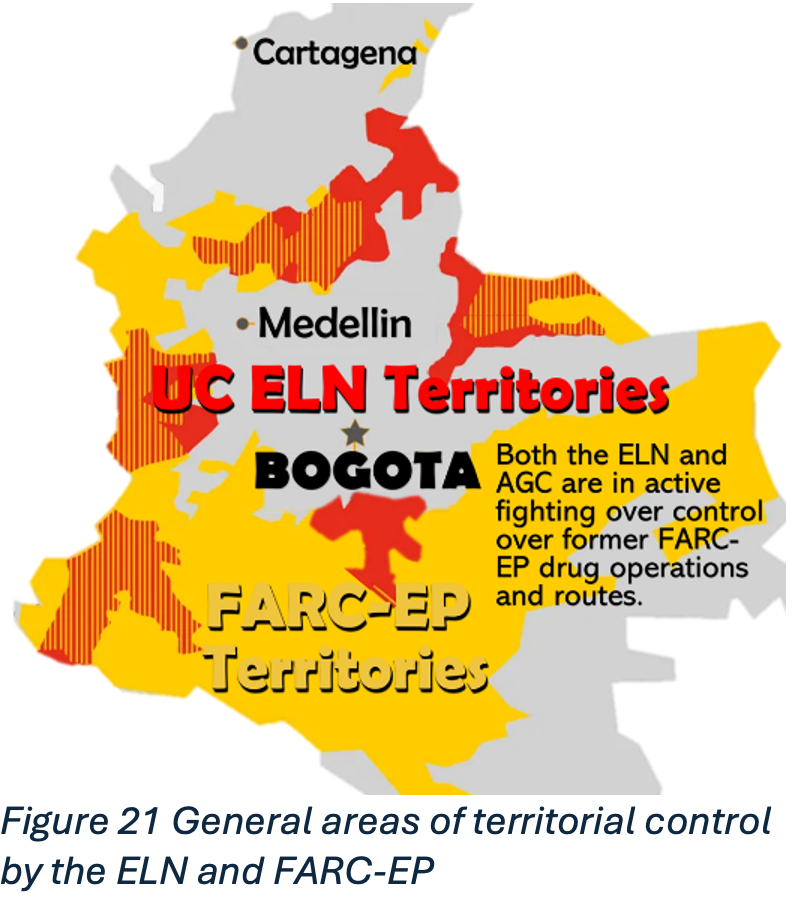
The National Liberation Army (ELN) is the oldest and one of the most powerful insurgent groups in Colombia. It seeks to control critical areas of the country—particularly those associated with drug trafficking—and frequently engages in armed confrontations with Colombian authorities. The ELN operates throughout Colombia, with its heaviest concentration in the country’s northwest and southwest. Estimates of their membership ranges between as few as 1,600 to as high as 5,000. The ELN conducts armed assaults, assassinations, extortion operations, and hostage-takings. The group mostly attacks the Colombian Government, military forces, and critical infrastructure but also targets civilians. The ELN equips its members with small arms, machineguns, mines, and IEDs. Operationally, the ELN competes with the right-wing auto defence paramilitaries for resources and territory, both in support of drug trafficking, and control of the population. From my external perspective as a couterinsurgency advisor to the Colombian government, separating the FARC-EP from the rural indigenous and mestizo population segments that fed its number was far more straightforward than what we would face with the ELN. Where the FARC-EP ideology was politically centred in communist or socialist reordering of Colombian society, the United Camalista National Liberation Army of Colombia UCELN had a far deeper emotional calling over its adherents. Figure 20 offers some of the object symbolism of the UCELN, beginning with the conceptualisation of Liberation Theology. Figure 21 illustrates some of the historical areas of control by the ELN and FAR, although these areas are always growing and changing. During the mid-20th century, disenchanted members of the clergy and the oppressed classes of Latin America united to reinterpret the role of the Catholic Church in everyday society and to reclaim religion towards the pursuit of social justice. Liberation theology encouraged a break from an elitist notion of the Church and the return of control to the people. By involving the poor in their own liberation and offering Christianity as a tool towards a more perfect society, liberation theologians dramatically changed the relationship between not only the Church and the state, but also the Church and the people. Guided by innovative Catholic priests Father Camilo Torres Restrepo in Colombia and Father Gustavo Gutiérrez in Peru, this movement reinvigorated marginalized people throughout Latin America, while still utilizing a formal theological approach. Though ultimately opposed by the Vatican because of its radical leanings, liberation theology implicated the Church in the ongoing struggle between the population segments of the Centaur State in Colombia. The ELN’s claim to Catholic theology as a basis of its social goals created an entirely new dilemma for the Catholic nation of Colombia, one that the Catholic Church was of little assistance in resolving. Liberation theology offered a home to large numbers of otherwise Eurocentric criollo Colombians based in widely accepted religious thought rather than debates over Marxist-Leninist ideology. Even though Colombia’s conservative right denounced liberation theology as simply a mask for Marxist-Leninism, the new theology allowed for dialogues and sales pitches to occur in contexts of religious righteousness rather than foreign political ideas. In 2007, I was charged with assisting the Governor of the Department of Caquetá and the Commanding General of the 6th Colombian Army Division with resettling a strategic town called La Union Peneya. The village of La Union Peneya (formerly of approximately 2000 inhabitants) was abandoned in July of 2002 when government troops from the 12th Brigade (responsible for defending the Department of Caquetá) and FARC Forces fought for control of the town. During fierce fighting between government forces and insurgents who used the town as a base of support and operations, significant portions of the town were badly damaged including the hospital clinic, church, both the elementary and high schools as well as most of the resident’s homes. As the fighting grew, the inhabitants (led by the town’s catholic priest) who were not active members of the FARC insurgency fled to homes of relatives in nearby villages and municipalities. After several months of intense fighting, government forces finally eliminated open FARC resistance in the Municipality of Montanita where La Union Peneya is located. The 12th Brigade’s Guipe Battalion then established a company sized outpost in the hills overlooking the town to secure it against a return of the rebel forces. For the next three and half years, the village of La Union Peneya remained abandoned, no-man’s land between the FARC-EP and the Colombian Army. The issues facing the resettling of the town were nearly beyond the capacity and authority of the departmental government and only with direct intervention by President Uribe and his Acción Social, was the project even possible. To even access the town’s population in nearby IDP camps, I was required to employ the offices of the bishop and priests who served as sort of gatekeepers to the vulnerable refugees. The issues to be resolved to the satisfaction of the church leaders included decisions on funding and access to repair the town’s schools and healthcare facilities left in ruins. More contentiously, only 15 of 367 families living in La Union Peneya had title or legal permission to live in the house they had built and lived in for generations. Similarly, only 32 of 80 established small farms were legally titled, and 48 small farmers who had been living on and working the farms for one or more generations did so with the knowledge that large family companies could or would, one day try to return and lay claim to them against their occupants. While the area of Caquetá was FARC rather than ELN, I found it easy to understand the lure of and integration in, Colombian rural society by the ELN and their Catholic liberation theology. The import of this is in the ELN’s ability to sustain its numbers in the field and provide a rationale for control over the civilian towns and farms with provide resources, manpower, intelligence, and obscurity from Colombian Armed Forces seeking to separate civilian from insurgent guerrilla. The steadily increasing violence by the right-wing self-defence forces appears to be focused on reigniting the armed conflict as a means to reenergise the Centaur State which is fuelled by the work of countering an insurgency, even if that insurgency is created by those who control the state.
§A5.2.2 Fuerzas Armadas Revolucionario de Colombia: Disarming, Demobilising, & Reintegrating the FARC-EP into Colombian Society – Most of it Anyways.

By the early 1990s when I began working with the Quechua in the Andean Mountain, several confederations of Quechua had merged with those of the Amazon Basin tribes to form united indigenous political alliances, which over the years evolved into well-organized and influential Indigenous movements in Latin America.11F34F Their grassroots organisational work proved able to incite rural uprisings of indigenous communities on a national scale. Thousands of people in the three Andean-Amazonian countries blocked roads, paralyzed the transport system, and shut down local, regional, and national governments in response to demands for bilingual education, agrarian reform, and recognition of their indigenous rights to land and autonomy. plurinational state of Ecuador. The combined indigenous movements shut down and occupied parliaments in Quito and Lima, while forcing Bogota to accede to restoration of rights in the various iterations of the Colombian constitutions that the new president Gustavo Petro and his vice-president Francia Márquez, are busy enforcing. During my years helping the Colombian government battle the FARC-EP and related leftist organisations, my/our struggle was not over control of the physical terrain, but rather, the human terrain. We fought for the hearts and minds of the population who were vulnerable to the FARC’s recruitment messaging; for the attention and acceptance of the young people susceptible to the FARC messaging of belonging to an ‘armed family’ fighting for their inclusion in an otherwise alienating superior elite. On one level, we fought the FARC messaging with direct counter messaging, such as in figure 23. On many more levels, we fought the FARC by emptying its ranks of fighters and supporters. By convincing the tens of thousands of tiny pueblecitos and the families within that their children and grandchildren would be better off in alignment with a nation that recognised itself as multicultural, multilingual, multiethnic, and respecting of all citizens without regard to socioeconomic power. Most all the initiatives that my team and I developed in conjunction with Colombia’s indigenous communities and our host nation partner, Colombian Government’s Acción Social, were ultimately accepted by the civilian governance, the COLAR and lastly, the COLPOL. This acceptance by the security and administrative services of those Colombian states that I was advising allowed us to turn the aspirations of the indigenous and marginalised mestizo communities inwards towards a social construction of a multi-world cosmology that did not necessitate the destruction of the pre-existing society. Because Plan Colombia was embraced by Colombia’s Eurocentric elite as the best chance for avoiding revolution, agreements to rebalance power – social, political, economic, legal, and natural resources to include land ownership, were made and the plan’s western financial backers ensured compliance. Each act of societal rebalance saw the Eurocentric elite’s margins of economic control weaken in favour of indigenous and mestizo peasants. The resistance was tremendous, and encased in old arguments about morality, Christianity, and the essential correctness of postcolonial racial and social stratification of Colombia by the Eurocentric elite.

The tipping point it seems was the election of Gustavo Petro and Francia Marquez, a former leftist insurgent fighter and an Afro-Latino. 36F I found that all the positive transformational change within the Colombian structure of society, participation, and governance under Plan Colombia, became unbearable to the other quarter of society. The graphic in figure 24 is one of the most ubiquitous messages of modern counterinsurgency ‘Hearts & Minds’ campaigns that I employ in my work and its focus was directed at the indigenous and Afro-Latino portions of the spectrum as those were the parts of Colombian society that were rebelling against the criollo led Eurocentric part of the country.

But even before the last Eurocentric conservative government was voted out in favour of Petro & Marquez, renewed physical resistance by the remnants of the Eurocentric self-defence forces or militias, pushed back against these social rebalancing agreements, in attempts to prevent lands and resources from being removed from their control. Towards the end of Colombia’s last conservative president, Iván Duque, millions of Colombians took to the streets to protest the conservative government of President Iván Duque, for failing to follow through with reforms agreed to after the demobilisation, disarmament, and reintegration of the FARC and related militant organisations.
From the continuation of enforcement of policies that advantaged Colombia’s Eurocentric elites, allowing environmental destruction, police brutality, and rampant corruption to continue. The government’s over-reaction left 44 people dead and over 3,000 wounded. Close to 1,500 protesters were arbitrarily detained. The systematic killings of leftists, student activists, and community leaders, all of whom played a pivotal role in the popular uprising, continued unabated, leading to the sweeping election of Petro and Marquez. Once elected, the Eurocentric elite fell into a profound psychosocial crisis and all former public dissociations by mainstream criollo society of close ties to drug trafficking, paramilitary death squads, and the military, were abandoned. In June 2022, Gustavo Petro made his final campaign speech from behind a wall of bulletproof shields and on June 19, he became the country’s first leftist-elected president in decades, after narrowly winning a runoff. His running mate, Afro-Colombian environmental activist Francia Márquez, also made history by becoming Colombia’s first Black vice president. Politicians on the right quickly laid fears of postelection disputes to rest by recognizing Petro’s win, and a peaceful transfer of power ensued. Political observers and participants in support of Petro & Marquez accuse former President Álvaro Uribe of being a right-wing populist who concentrated power during his 2002–10 presidency , as well as his successor and defence minister, Juan Manuel Santos (2010 – 2018), who oversaw the final FARC-EP demobilisation, a half-century endeavour. Having worked with both President Uribe and Santos, I witnessed firsthand their actions to pushback against their own Eurocentric elite to rebalance Colombian society and end the leftist insurgency. My professional opinion is that by the time former President Iván Duque (2018 to 2022) assumed the presidency, the anger and frustration of the postcolonial Eurocentric elite boiled over and pushed his administration to backslide on too many of the promises made by Uribe and Santos, leading to a nationwide mobilisation that brought Petro & Marquez to power. What made their electoral win so amazing was that, in Colombia, in all sectors, there was a profound stigma attached to running as a leftist in a country long terrorized by left-wing insurgencies. The recently demobilised FARC had a brutal record of kidnapping and killing civilians and forcibly recruiting child soldiers. Prior to the 2022 election, many of the non-Eurocentric sectors of Colombian society saw left-wing parties and candidates as guilty of violence by association, even when they campaigned on platforms of non-violent change.

§A5.3 “Autodefensas Gaitanistas de Colombia” (AGC) is a “Class A Organized Armed Group” – Colombia Department of Justice.

The AGC’s pedigrees include all the AUC and the Medellin Cartel from which they either emerged or subsumed.56F This means that every compromised judge, politician, public official, prosecutor, police and military official that accepted money and favours from nearly all the country’s violent actors are subject to compliancy to the AGC and its leaders, Ontoniel, and Jobanis de Jesús Ávila Villadiego his deputy as shown in figure 26. There are no lavish parties, no outward signs of ostentatious displays of wealth; the organisation remains in the shadows, protected by its Eurocentric beneficiaries. For years after its formation in the wake of President Uribe’s decision to extradite the leaders of the AUC to the United States, the Santos administration continued to refute that the AGC had formed, insisting that it had demobilised in 2008 with the capture and extradition of its leadership. Meanwhile, the AGC continued its territorial expansion all the way to the Venezuelan border. Colombian media reports throughout 2012 estimated the groups grew to have between 1,300 and 2,000 fighters. The AGC’s orientation towards the protection of and the enforcement for, the Centaur state’s Eurocentric elite, is central to its survival.
The Eurocentric population in Colombia support and protect the AGC willingly (for benefit) and unwillingly (because they are compromised). In return, the AGC ensures that all or most of Colombia’s drug trade benefits individuals, institutions, and core Eurocentric ideologies of the white elite.

To be sure, this relationship is neither direct nor easily visible, especially to those in the middle and upper middle classes who most benefit. Rural farmers whose cultivation of the valuable coco crops is protected by the AGC understand the direct benefit relationship, but merchants in Bogota whose business booms from the inflow of billions of Euros annually, are often not so fully aware. To ensure harmony in their efforts, the AGC has worked to build alliances with other rearmed paramilitaries in central Colombia. In late 2013 and mid-year 2014, the AGC evolved their public presence, establishing a website and newspaper and calling themselves a “military-political organization.” In response, President Juan Manuel Santos in 2014 changed the group’s name to “Clan Usuga,” after Ontoniel’s family name, attempting to brand them as an ethnic family-based mestizo-indigenous drug trafficking organization rather than an AUC dissident groups. Doing so helped Santos’s narrative that the Eurocentric elite of Colombia were no longer in the business of supporting the drug trade. In February 2015, Colombia’s security forces began “Operation Agamenon,” the biggest manhunt since Pablo Escobar in the hope to arrest or kill Otoniel. More than 2,000 policemen and soldiers were deployed in the Uraba region, but without result. When the Clan Usuga naming failed to garner traction, Santos’ administration again renamed the group, this time calling them the “Gulf Clan,” and have consistently avoided to acknowledge the group’s paramilitary origins and nature. In late 2017 and early 2018, with the new conservative party of Uribe’s protégé, Ivan Duque, the AUC sought to engage the government in talks about standing down the AGC, but under the condition that the organisation would be shielded from extradition and guarantees that would prevent the formation of new guerrilla and paramilitary groups in regions under his control. During this round of negotiations, the Colombian prosecutor’s office learned that it would have to deal with 7,000 members of the AGC, the best clarification of its strength in a decade.

The talks did not go well and triggered a split with other former AUC members who distrusted the government and some AGC segments distanced themselves in Bajo Antioquia. In early 2018, the government said to be close to an agreement that would allow the AGC to collectively surrender to justice, but when Santos left office in August 2018, the AGC were still in arms and appeared increasingly alarmed about the government failures to comply with the peace deal made with the FARC. President Ivan Duque ended all negotiations and the AGC focused on their wars over abandoned FARC territory with the remaining ELN in Choco and the Chaparajos in Antioquia. The new government of Ivan Duque contradicted previous claims about the group’s size and said in early 2019 that the group was no bigger than 1,500 members. Rumours have since been that Otoniel and Avila Villadiego have moved their centre of operation to Bajo Cauca. In 2021, US and UK intelligence agencies and US Special Forces Advisors, located Otoniel in Panama, near the border with Antioquia Colombia. Along with US Advisors, 500 members of Colombia’s special forces and 22 helicopters were used in the jungle raid to capture Ontoniel alive. Only a single Colombian police officer was killed during the raid and capture. Colombian President Ivan Duque quickly announced Ontoniel’s capture and extradition, but not before Colombia’s Truth Commission tried to interview him about the AGC’s links to Colombian government officials. After Bogota’s W Radio began reported that Otoniel had begun revealing ties between the “world’s most wanted drug trafficker” and Colombia’s security forces, Colombia’s National Police Intelligence Agency (DIJIN) interrupted the interviews and cancelled all interaction between Ontoniel and the outside world, holding him in a high-security wing at the DIJIN in Bogota, which is a basement that is reinforced in concrete with armoured doors and seven security cameras that permanently watch and record him. In response to President Duque’s announcement of Ontoniel’s extradition to the United States and his claim that his capture has led to the collapse of the AGC/Gulf Clan, the new chief, Jobanis Villadiego, ordered a four-day siege of 11 of Colombia’s 32 departments in a show of force. The Gulf Clan took control of 11 of Colombia’s 32 departments over the four-day span. A total of 178 different municipalities in the country were under Gulf Clan control, with 138 of them under strict lockdown rules. The AGC imposed strict lockdowns, shuttered local businesses, closed off roads, disrupted transportation links, and warned residents to stay inside or risk being shot or having their vehicles burned. Several towns ran out of basic supplies such as food and gas, while local hospitals faced staff shortages. Elsewhere, families were stranded at transport terminals, unable to get home due to blocked roads, local media reported. “You live with the concern that it could happen again tomorrow,” said another resident of Tierralta, Raul, who also asked to use a pseudonym because of security concerns. “Because the Gulf Clan are showing that they have the power to create fear,” he told Al Jazeera.

“The government response to this event leaves people more dissatisfied with their ability to express their political ideas or to participate in democracy. This event is very, very detrimental to the quality of democracy in Colombia and to the local perceptions of security,” said Sergio Guzman, director of the Colombia Risk Analysis consultancy group.
During the “strike”, the Gulf Clan committed at least 309 acts of violence, according to the Special Jurisdiction of Peace (JEP) tribunal, which also registered the forced closure of 26 roads, the destruction of at least 118 vehicles and the disruption of 54 transport terminals. “They wanted to demonstrate their military strength to show that in many areas of the country they are the de facto authority and not the state,” said a JEP representative, who spoke to Al Jazeera on condition of anonymity to speak freely. Twenty-four civilians were killed during the “strike”, the JEP also said, and a further 15 attempted murders were recorded. The Ministry of Defence reported six deaths, while NGO Indepaz recorded 18 over the course of the strike. The JEP official told Al Jazeera that three social leaders – a term used in Colombia to describe activists, community representatives and rights defenders – were among those killed. “This event underscores how much the government underestimated the nature of the [Gulf Clan’s] threat. This is very complicated for the government to somehow spin this towards anything but a robust failure of their security strategy,” Guzman told Al Jazeera.
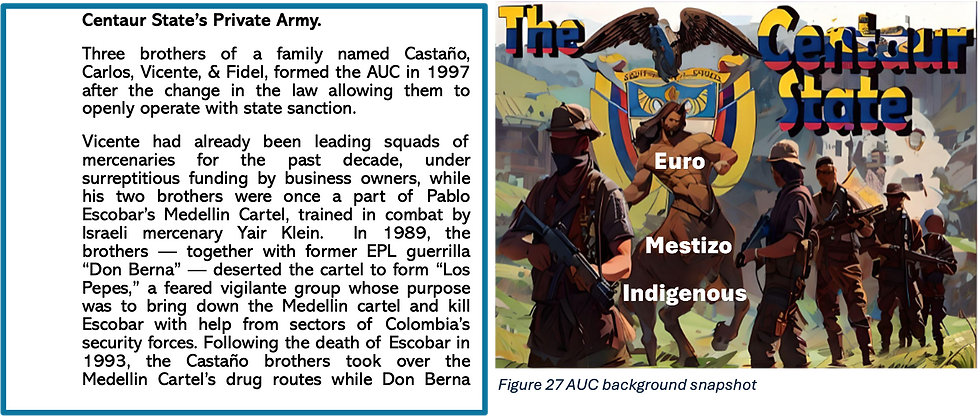
Despite the strike being announced early on May 4, no military response from the government was seen until May 7, when troops were deployed to the affected Bolivar, Sucre, Cordoba and Antioquia regions to accompany vehicles and secure the roads. According to Ministry of Defence data, more than 19,000 troops were deployed across the area. “The Gulf Clan just ripped a hole through the narrative by making it difficult for the government to assert its authority over one-third of its territory.” The subsequent events after Ontoniel’s capture, however, have shown a spotlight onto subjects that could potentially bring down the Colombian state and beyond. Colombia’s Truth Commission was and outgrowth of the 2016 Peace Accord between the Colombian Government and the FARC- EP. After Ontoniel’s capture, he indicated his willingness to speak to the Truth Commission’s Special Jurisdiction for Peace, JEP. During the two days of recorded testimony, Otoniel disclosed a part of the vast quantify of information that explain the multiple decades long records of the AUC and AGC’s interactions with the official part of the Colombian state and with the businesses, corporations, and families that have the greatest control and influence over it. My sources in the Colombian Army, now retired, believe that Ontoniel’s goal was to create a position for himself where he would be able to leverage his large base of knowledge about the relationship between the right-wing paramilitary organisations and the government and powerful families who have been benefiting from their violent hold over Colombian society for decades. They have informed me that as soon as the commission began to release parts of Ontoniel’s testimony, the national police under President Duque, suspended their access to him and denied any further communications. My sources believe that Ontoniel’s confessional interaction with the Truth Commission was his attempt at extorting President Duque to cancel his extradition to the USA and to allow him to manipulate the Colombian government for the benefit of his AGC. The brazen theft of commission evidence appeared to have been an indication that those whose lives would be implicated by Ontoniel’s testimony were both powerful and motivated to ensure his silence and his extradition to the US.


Comments