

Cultural Pathologies of Alienation, Shame, and Rage, in Latin America’s Ruling Mestizo Classes.
Within the socioeconomic upper quartile of ethnic mestizo families of Ecuador’s urban centres (and several other Latin American nations), there exists a pathological psychosocial dynamic that has accompanied the deterioration of society. This psychosocial pathology is based on trauma that has been transmitted generationally over the course of colonial and post-colonial social construction and involves a powerful condition of racial inferiority within the inheritors of Post Colombian society. The trauma, or broken reality transmitted was that physical beauty and psychological value-as-love was encapsulated within the phenotype and archetype (prototype) of the Peninsulares-Criollos of Caucasian Europeans. This racial-inferiority cultural dynamic presents itself in a social, political, and economic practice of Blanqueamiento (whitening) to mejorar la raza (improve the race). During our research in Ecuador (and other countries), we found there to be a commonly accepted cultural imperative where each family felt ‘called upon’ to achieve a supposed ideal of biological and symbolic ‘whiteness’ or Europeanness.
Our field research found several markers of this pathology such as parents sending their children to the United States or Europe to find a marriage partner. Parents of the affected cultural pathology demonstrated a strong preference for books, movies, and stories that depicted positive-heroic-beauty phenotypes and archetypes quite dissimilar to their own. During our research in Quito and Lima, we interviewed phenotypical mestizo women about their preferences for love interests and heroic ideas in romance novellas and telenovelas. A significant majority of responses demonstrated preferences for blond haired, blue- or green-eyed men and women with fair Caucasian complexions. These same phenotypes and archetypes were and are still, disproportionately represented in telenovelas, books, and magazines, especially in households closer to the upper echelons of the socioeconomic elite in the capital cities of Latin America. The most popular heroes and heroines in film and literature are blond haired, blue/green-eyed

light-skinned European looking actors, even though those phenotypes have not been present in this region for decades. Racial preferences became clear as we researched into the desired cultural prototypes of social and business interaction between the economic groups. Our research with post-pubescent teenagers confirmed the transmission of this phenotype/archetype preference of Euro-Centric Caucasian over their own mixed heritage mestizo typology, with accompanying emotional displays of ‘learned-shame’ and guilt. While the practice of Blanqueamiento works to affirmatively change racial identity of the dominant segment of mestizo society, other practices work to defend against subconscious threats of racial identity disintegration such as demonizing darker-skinned segments of society. The president of Guatemala from 2016 to 2021, for instance, was Jimmy Morales, a stand-up comedian who came to local fame portraying a blackface character that denigrated Afro-Latinos, which account for around 02% of the population. The graphic in figure 10 offers some context into this aspect of psychopathology of the upper-class ruling community of Quito. The psychological and emotional relief that the audience and comedians are constructing through comedic relief emanates from the racial disparagement and subsequent demonization of a tiny Afro-Latino minority group. The release they seek is from cognitive dissonance, anxiety, and stress caused by their own negative inner self-estimation of value compared to their preferred prototypes (phenotypes and archetypes combined) of personhood and family identity. The targeted African-Latino populations feel only loathing towards this type of show, and the indigenous Amerindians express confusion and disdain.
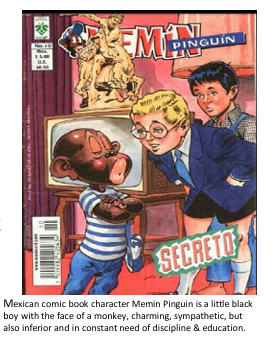
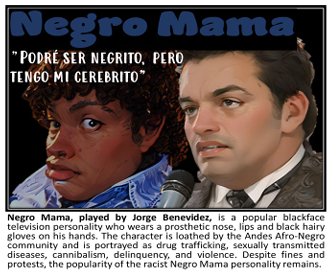


Those social members whose bloodlines are impure variations of Peninsulares Criollo and indigenous Quechuan can fight against their impurity by resorting to the practice of Blanqueamiento. Or they can resort to ethnic-defection (abandoning their Euro-bloodline) to the one side (of the social contest) that will allow them to join without negative stereotyping and embrace, highlight, support their indigenous phenotype and archetype over their Spanish side. The research interest in this aspect of Ecuadorian social conflict is in how the Mestizo ruling class sees themselves, portrays themselves, cares about themselves, and ultimately, loves themselves as their own real phenotypes, rather than the phenotypes they wish to be. Subconscious self-denigration of one’s own phenotype can have devastating social ramifications as we have researched in many violent conflict zones. At this time, more research is required to be conducted to understand the linkages between social dysfunction in Latin America and the rise and sustainment of extremely violent criminal organizations and intractable conflict between Eurocentric and Indigenous-Centric national identities.
However, a central part of psychological warfare is the inculcation of alienation and shame, often from self-loathing that is borne out of an idea that the targeted persons are ugly. Unlovable. Untouchable. Uneducated. Worthless. Outcasts. Dirty. Impotent. The most immediately assuaging and instinctual response to self-loathing is the sort of violent rejection that we are seeing playout in Quito and Lima specifically, and Ecuador and Peru generally. The only question remains is how destructive this action-reaction over Ecuadorian collective and individual identity will become.


Comments