

Indigenous Awakening: A Emergent Ideology of National Life – Quechua Pacha.
Indigenous Awakening: A Emergent Ideology of National Life – Quechua Pacha.
Euro-centric population segment does not necessarily constitute an ‘elite’ society. Rather, they are part of a cultural identity worldview that is identifiable (in reality and/or by perception) by both phenotype and archetype. The difference that Indigenous archetypes of personhood, family, and society are from European is perhaps difficult to comprehend for many. Figure 12 illustrates the distributions and populations of the non-Eurocentric populations of Colombia and the general phenotype of one of the larger indigenous communities native to the Andes Mountain Rages of Colombia, Peru, and Ecuador – the Quechuan. Amerindian phenotypes are characterised by lower levels of melanin deficiency than Europeans and varying degrees of dorsal hump over the nasal bridge. The tip of the nose is

broad and downward facing. Some members of the Amerindian ethnicity have used rhinoplasty surgery to ease the degree of the dorsal hump, however, most Quechuas that we have interviewed and engaged with find it to be a pleasing aesthetic in their culture. The criollo or near criollo members of Colombian, Peruvian, and Ecuadorian society, normatively feature classical southwest European features in facial topography, hair, and body type. The point made here is that Colombia’s population segments are well attuned to the distinctive criollo or near criollo phenotypes that mark them as distinctive. With this phenotype comes a set of stereotypes about the criollo’s likely socioeconomic and political status and views that are not accurate for all members. In the valleys of the Sierra region of the Andean Mountain Range, our qualitative interviews revealed that many, if
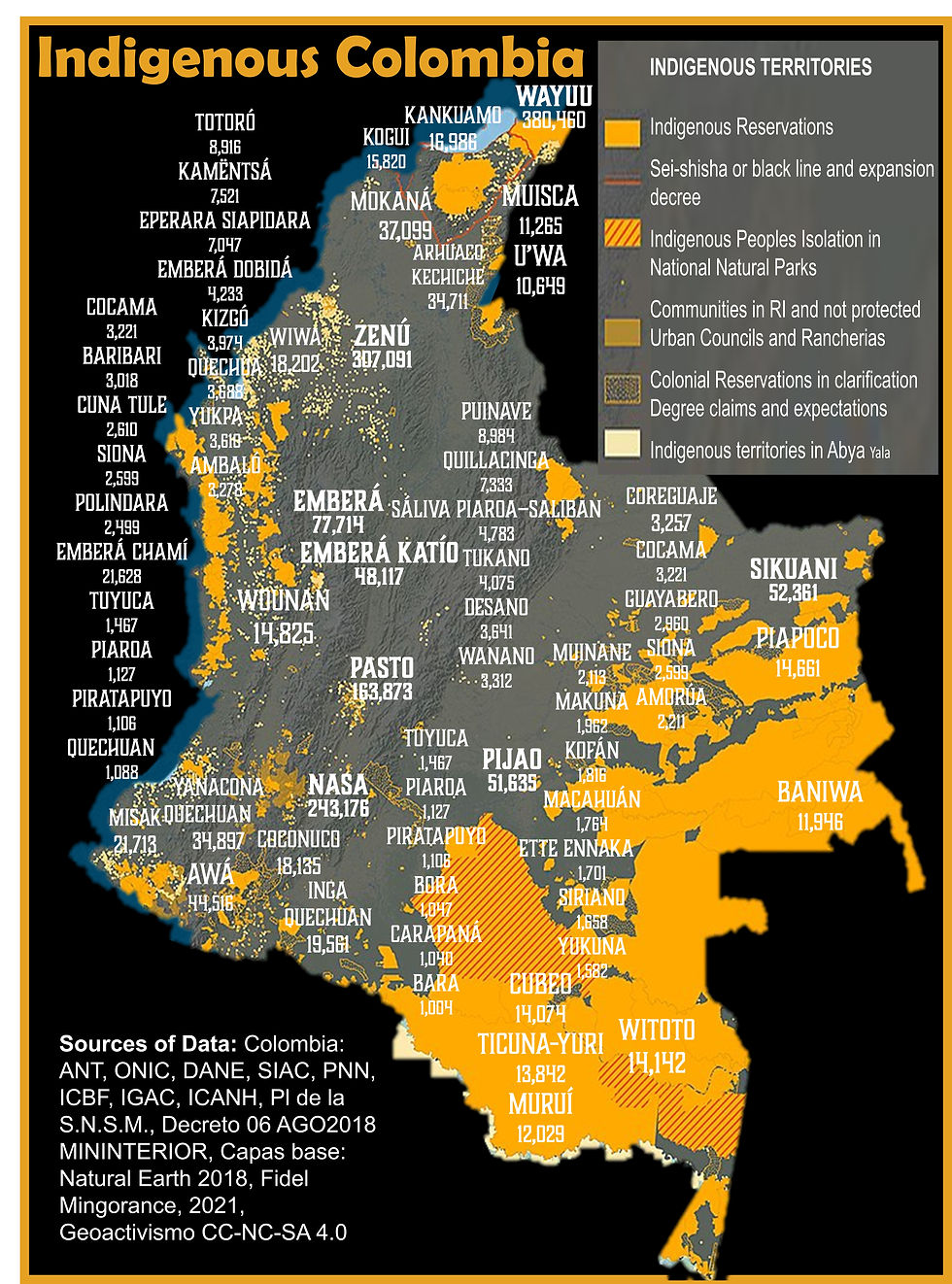
not most of the residents that we engaged described themselves and their families as part of an Andean Indigenous world. The further from the large urban cities, the greater awareness of and pride within, their alternate constructions of life and family. The communities of mestizo population segments in both the highlands and greater Amazon basin present as having somewhat less feelings of membership within the indigenous categorisation of their society and displayed some confusion over their place in Colombian, Peruvian, and Ecuadorian society. When we asked them about their responses to census questionnaires (criollo, mestizo, indigenous, or Afro-Latino) our interviewees responded by asking if their ability to conduct business in Spanish; or if one of their ancestors had the blood of a Spaniard; or if any of their family members displayed the physical characteristics of a European; then did any of those questions mean that they were Mestizos Qualitatively, our interview respondents described their existence as an in-between existence of part indigenous and part European, with a constant evaluation and re-evaluation of which half of their identity was preferred, desirable, stable, accepted, and ultimately, lovable by self and each other. Within Colombia’s mestizo population in the Amazon basin, we recorded qualitatively and quantitatively, a movement of merger towards evolution of indigenous identity that ignored European stereotypes of naked natives with feathers, spears, and blowguns. While some subtribes of the Waoroni peoples of the Amazon have continued such an existence, the evolution of indigenous identity and cultural life seeks to bridge two complex realities. We found during our field research that most indigenous people whom we interviewed believed that they lived in two worlds. The first was the world of the Spanish Colonial administration that perpetuated their rule long after they achieved separation from Europe. The second was their own Andean and or Amazonian Indian world that we learned was called Tawantinsuya, or ‘Realm of the Four Parts’. This inner world of indigenous life shaped and harboured their collective identities, historical narrative, and memorialisation of their lives through songs, stories, artifacts, clothing, architecture, food, social construction, and psychological organisation. The descriptive narrative of indigenous life between Andean, Amazonian, and Afro-Latino has rich variety, and for the sake of brevity, the rest of my description of Colombia’s indigenous community is based on the significant Quechua peoples of the Andean Mountains which have their origin Peru’s portion of the Andes Mountains and extend northward into Ecuador where they are Kichwa Quechan, and Colombia with they are called Inga Kichwa Quechuan. The Quechua word for a Quechua speaker is runa or nuna ("person"); the plural is runakuna or nunakuna ("people"). "Quechua speakers call themselves Runa - simply translated, "the people" and their overarching language collective is called Runasimi. Their family-clan-tribe names include the Caranqui, the Otavaleños, the Cayambi, the Pichincha, the Panzaleo, the Chimbuelo, the Salasacan, the Tungurahua, the Tugua, the Waranka, the Purua, the Canari, and the Saraguro, to name the most prominent. An electorally significant number of Colombian, Peruvian, and Ecuadorian citizens who have historically been classified by government administrations as Spanish mixed blood, or mestizo, have always identified as indigenous. We found that this large segment spoke some or all their most intimate conversations at home in their individual indigenous languages or in the Runasimi bridge language. We found that few families in this category possessed oral stories, poems, songs, and carvings in the colonial language of the Spanish. We found that their normalised use of Spanish was minimally sufficient as a language to bridge their lives with the Spanish governing administration. As one moves beyond the paved roads and other markers of European civilizations in Bogota, Medellin, Quito and Lima, you emerge into a vastly different world than

what is often envisioned by people who have never lived there. Within the Spanish speaking capitals of Colombia, Peru, or Ecuador, Spanish Mestizo elites maintain a pattern of European life and psychological symbolic objects that seem distinctly ethnic yet possess a surprising familiarity to the European Peninsulares visiting from Spain. To the millions of non-Spanish speaking inhabitants of these countries, these capital cities are mental symbolic objects of a familiar but foreign occupation, and for some or many, a subjugation of indigenous collective identity. Figure 13 illustrates just how different the Andean Quechuan psychosocial reality is from the post-colonial European, an important part of why it is so fiercely resisted by the portion of mestizo communities who identify as European. The graphic illustration depicted gives an idea that Colombia, Peru, and Ecuador’s Eurocentric population are not merely being racist in their rejection of indigenous life but their acceptance of anything indigenous involves core changes to Eurocentric psychosocial identity. The Quechua word sumak literally translates roughly into ‘ideal purpose’ and kawsay roughly translates into ‘life’. These two Quechuan words have been used by the indigenous peoples of pre-Columbian society to create a diffuse neo-logical conceptualisation of psychosocial-emotional construction of life that is based on ancestral indigenous ideas. These ancestral ideological concepts predate the Incan Empire by as much as 1,000 years and were incorporated by the Inca rulers into their conceptualisation of their empire. European oriented Spanish intellectuals and scholars in Ecuador, Bolivia, and Peru, have translated Sumak-kawsay into Spanish as Buen vivir, or ‘Good life’ focused on collective wellbeing, social responsibility, and an alternative to traditional development and capital accumulation. Indigenous leaders were quick to appreciate this initial acceptance by the Spanish elite, until the concepts became ‘re-imagined’ as modifications of the existing socio-political-economic order that kept most of the western based Westphalian state model intact. Agreements on the translation of indigenous psychosocial-emotional reality (collective and individual) would quickly fracture leaving growing chaos and confusion about the real intentions of the indigenous communities. This chaos and confusion translated, in turn, to the loss of common ground on which to base winning electoral coalitions that could achieve sufficient unity to govern. Both Euro-centric Spanish and Indigenous-Centric political organisations are discovering that the emerging indigenous translations of ancient cosmology may be incompatible with existing European social constructions. This incompatibility has always been a concern of the Spanish inheritors of post colonial Colombia, Ecuador and Peru, hence the structuring of national censuses that ‘guided’ the populations’ responses towards a more unified version of cultural assimilation. Unfortunately for those who dream of keeping Colombia, Ecuador, and Peru as European statelets of democracy, most full and partial blood indigenous people remained deep within their own cosmological reality and simply co-existed with their rulers. Until the present day that is. Since my earliest days operating within the indigenous societies of the Amazon and Andean Mountains, we’ve observed and researched this diffuse conceptualisation as it crystalised into political thought, followed by political activities of electoral organisation, representation, negotiation, and finally, legislation. The conceptualisation of indigenous Sumak-Kawsay in its purest form, would if allowed, transform Colombia, Ecuador and Peru from nation-states that are European-orientations to ones that are remade into modern versions of social communities modelled after the Tawantinsuyu civilisations of the Incan Empire. The sprawl of tribes, clans, families of the Andean Mountain Ranges and greater Amazon Basin have, until recently, constituted an invisible world that operates beyond the control of the Eurocentric Spanish-oriented governing administrations.


Comments