

Religious and Ethnic Conflict in Mali, Niger, and Burkina Faso
Religious and Ethnic Conflict in Mali, Niger, and Burkina Faso.
Bamako is one of three capital urban centres in the central Sahel, the others being Niamey Niger, and Ouagadougou Burkina Faso. These three urban centres are large collections of families-clans of the local tribes who inhabited these areas prior to colonisation by France and now house family-clan communities that represent the tribes from the remainder of the country as well as the region.

The graphic in figure 2 illustrates that these urban metropolitan capitals are all in mixed areas of religious competition between Sufi-Islam, Salafi-Islam, Christian Evangelism, and various forms
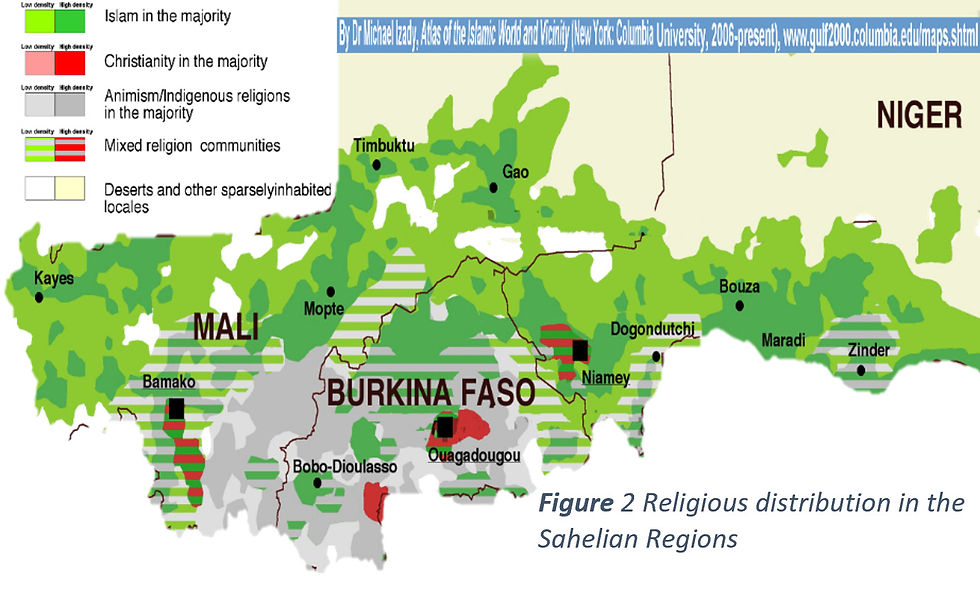
of Indigenous Animist systems of belief. These cultural identity structures of metaphysical belief have become intensely violent with Salafist and Sufi Islam in contests of apostasy, while animist and Christian systems have their own, at times, violent, contests. Islam versus Islam; indigenous versus Christian, and Christian and Islam versus pagan animist, create a complex web of extremist ideologies. The graphic in figure 3 shows the religious and tribal affiliations and defections in the areas of Burkina Faso, which are adjacent to southern Mali and Niger.

From this depiction, you can visualise the constantly changing dynamics of religious, ethnic, tribal cultural identity that families navigate within each generation. These changing dynamics and competition for metaphysical following creates intense conflicts between and within nearly every community. These conflicts are not limited to Muslim-Christian, but Muslim versus Animist beliefs that are even more contrary than Christianity. These competing systems overlay another
set of competing systems of competing structures of religious and ethnic-linguistic identity are the political boundaries of these three states. For Mali and Niger, in figure 4, their ethnic and linguistic populations are further subdivided into two main groupings – African versus non-African. The majority ethnic-linguistic communities in power in the greater capital regions of Bamako, Niamey, and Ouagadougou, all consider themselves to be African in terms of largest group belonging. They are also predominantly sedentary in their economic pursuits, whether that be agriculture, animal husbandry, trading, manufacturing, and so on.

In Bamako, (figure 4, Mali’s simplified spatial distribution of its population segments the dominant tribe is the Bambara and Malinke whose numbers are overrepresented in government services due to their proximity to the seat of government power. The remainder of the capital cities house families-clans that are well connected to their tribal affiliations outside of the country and serve a communal function of communications, remittances, and generally, looking after their tribal affiliations’ needs and interests. At the bottom of each capital’s human societies are those men, women, and children who have either a tenuous connection to their ethnic-tribal collective or have been cut off, cast out, or are from tribes that are not represented or wanted in the capital. Individuals and families’ bloodlines in these three countries is central to their belonging, social-security, safety, and ultimately, their physical-psychological-social survival.

The extract from the UK SOF Civil Engagement textbook in figure 5 gives an eye-opening illustration of one of the many ethnic conflicts in Mali, this one between the Dogon Farmers-Hunters and the Fulani nomadic pastoralists in the Mopti region north of Bamako. We created this graphic novel format textbook to help UK SOF operators engage the population prior to the last coup de etat of 2021. The contents are as applicable today as they were then. The conflicts in Mali, Niger, and Burkina Faso are about farmers and pastoralists. The farmers are sedentary, and the pastoralists are nomadic. Many of the Farmers tend towards Animism and or Christianity, while many of the pastoralists and nomadic families tend towards Islam. Thus, the subsistence survival of both becomes enmeshed in religious beliefs that are weaponised by external violent extremist actors, as well as internal political actors. The dialogue captured in figure 5 is from qualitative interviews and field missions in Mali and Niger and illustrates the nature of the violent interpersonal conflicts between tribes.


Comments