

Survival & Disintegration of Ecuador’s Euro-centric society.
This report describes Ecuadorian asylees’ possibilities of surviving if they are involuntarily returned to Ecuador. Long before the current Eurocentric elite population segment of Ecuador graduated from high school, the multiple sides of the conflict in Ecuador were already firmly established. Like President Noboa’s family, most, if not all, elite criollo families in Ecuador were and are the beneficiaries of their Spanish ethnic colonial patrimony. Many Criollo people and families are unable to trace their family roots to the original conquistadors and their families to prove or disprove that their socioeconomic and political standing were the result of colonial conquest. But they don’t need to.
The shape of their faces, color of their skin, lineage of family names, quality of their spoken and written Spanish (often Castilian), along with the absence of any family narrative in Runasimi language, marks them with the ‘particularity’ of the inherited colonial elite. Their ancestors employed measures to control the non-European elements living in their state, but these measures are no longer possible, without being subject to indictment by the International Criminal Court for crimes against humanity.
This statement is NOT necessarily to assert any fault against those criollos who flee into exile or remain in Ecuador. The fact that they are fleeing their homeland from a malformed post-colonial criminal society rather than being protected by it, suggests that they are unwilling or unable to answer the two questions posed in this report.
A growing number of Ecuador’s Eurocentric elite are consciously and of-conscience, rejecting their participation in sustaining this structure and enter into opposition against it as lawyers, activists, journalists, and political candidates. The survival rate for the Euro class of Ecuadorians living in any city in an unprotected status is limited as they become a target of both the criminal societies and the criminal structures within the state. Ultimately, this is a contest between the two over control of the population and its resources. The majority of Ecuadorians who are ‘neither Indigenous nor European’ are caught in the middle as without protection. They pay extortion-taxation to the ever evolving and growing criminal societies. Their children are taken as fighters for the police, army, and criminal societies and for sexual exploitation. Shopkeepers, community leaders, even water providers, trash collectors and schools are forced to pay a tax to criminal groups in exchange for their safety. Large well-resourced commercial entities find it easier to pay the criminal societies rather than engage in armed conflict with criminal societies that have little to lose. Even mid to low level government employees who are too far down the food chain to warrant personal security protection, face ‘plata o plomo’ pay with your money or your life. Inside prisons, extortion has been common for years. On a recent morning in Guayaquil, Katarine, 30, a mother of three, sat on a curb outside the country’s largest prison. Her husband, a banana farmer, had been taken into custody five days before, she said, following a street fight.
“He called me from prison, asking that I wire money to a bank account belonging to a gang. If we didn’t pay, he explained, he would be beaten, possibly electrocuted. I was able to sell some things and had around $263 to send them, nearly a month’s wage from work. I was more than desperate, and do not understand why the authorities were not doing more to control this practice. Every person thrown into prison is another taxpayer for the criminal groups.”
The levels and types of gratuitous violence in Ecuador has been growing exponentially since 2019. Massacres, kidnappings and extortions multiply annually in Ecuador. At the behest of security institutions, politicians and parliament focus on hunt and kill/capture of leaders and their immediate ‘high-value’ staffs as a measure of progress. As the fight descends, the focus moves to ‘body-counts’ as key-indicators (KI) of success.

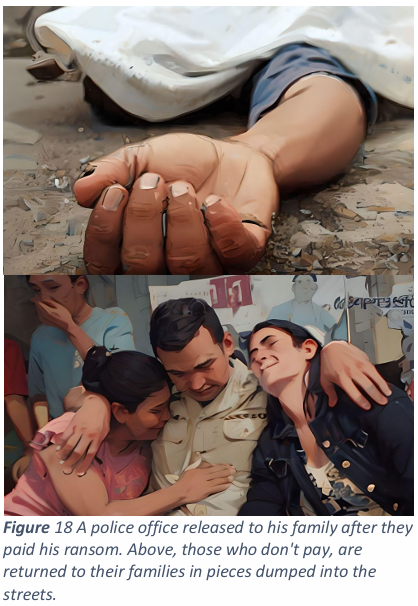
Many of Valka-Mir Foundation’s social scientists have extensive experience supporting kinetic military operations against criminal social organisations and or insurgencies. Our experiences have taught us that kinetic operations have never resolved this type of conflict no matter how many ‘high-value’ targets were removed. This is because such high-value targets, like the violence that surrounds them, are symptoms rather than the causes of a condition far more serious than opportunistic criminal sadists. It is true that crime has taken a sadistic turn in Ecuador, where kidnappers now regularly amputate the fingers of their victims and send images to pressure relatives to pay higher ransoms. This type of casual violence – the dismembering of human victims and sending their body parts to their families – is also an important diagnostic symptom of a society in the throes of critical psychosocial pathologies. Much of our understanding of this comes from my research in Northeast Syria researching the human refuse left behind by the Islamic State of Syria and Levant. These types of psychopathologies, like serial murders, are not normal profit driven crimes that can be solved with political science or criminal justice analysis. The brokenness, for lack of a better word, runs much deeper as must the analysis. The intentionality of the actions conducted by relatively low level and young members of the many criminal societies in Ecuador is the key to understanding what is happening and why. In March, the wife of a businessman in the port city of Guayaquil received images of someone snipping two fingers off her husband's left hand, threatening to mutilate him further unless they were paid $100,000. Each new president publicly assures national and international observers that security service leaders are trying to protect all Ecuadorians. In practice and regardless of political party in power however, the sociopolitical and economic supporters of the Euro-centric state perceive the success of the indigenous political agenda in stark existential terms that must be dealt with as such.
“The repression by President Guillermo Lasso’s government of demonstrations called by Indigenous, trade union and social organisations as part of a national strike since 13 June 2022 is causing a human rights crisis with many reports of harassment, excessive use of force, arbitrary arrests, ill-treatment, and criminalisation of protesters, journalists, and human rights defenders.”
To be fair, the levels of social discord, vehemence, the intensity of the political violence combined with the massive violent crime and gang problems, likely overwhelm the security services pushing them into violent overreaction. While our research over the past several decades suggests that the current course of indigenous terraforming of the political system
is unlikely to be reversed, in the short-term, the danger to the unprotected middle population of Ecuador should not be underestimated. As social scientists, Valka-Mir can never be certain of any predictive outcome, our experiences researching the political and social violence in the Northern Triangle of Central America, Colombia, Peru, and Venezuela, suggest that rapid social changes between communities with vastly different psychological organization and sociological constructions often involve great suffering and loss. An essential aspect of understanding the situation in Ecuador relative to mestizo families is encapsulated by dialogue that we recorded in Quito during one of our field research events:
Self-Identifying Indigenous Ecuadorian Mestizo speaking to Self-Identifying Spanish Ecuadorian Mestizo: “How can you call yourself a Spanish person when you look more like an Amerindian than a Caucasian?”
The central question of cultural identity appears to be driving the intensity and personalisation of the political violence as the contest of each political race helps determine whether Ecuador remains a Eurocentric cultural state. The political situation over the past three decades has evolved into one of active political instability marked by extreme social and economic insecurity that has activated nearly all the Ecuador’s population segments. The indigenous Quechua and Amazonia peoples have only become politically active over the past four decades of Ecuador’s independent existence, and their electoral numbers; willingness to sacrifice and engage the security services, has forced most of Ecuadorians into choosing sides. The indigenous community of Ecuador in opposition to the Eurocentric government has been highly effective in recruiting mestizo’s who previously thought of themselves as Spanish, to begin focusing on their Amerindian identity instead. The darker skinned mestizos, least likely to be accepted as beneficiaries of a system that rewards ethnic lineage, are the political middle that both sides are contesting. The political violence between the growing indigenous movement in Ecuador and the postcolonial social establishment will only continue to deepen as the stakes become better understood. The entire system of financial and capital investments held by a large minority of Ecuadorians is at stake and they will not willingly surrender their physical and cultural patrimony without a fight. The indigenous forces in Ecuador, meanwhile, have been bolstered by their ability to sell their indigenous narrative to most mestizo families who are being enticed to give up on their Eurocentric half and return to their Quechuan Raiz (roots) as an option that is better than what they now face. In recent years, Ecuador has undergone a sharp decline in most measures of development and public wellbeing and has been backsliding towards lawlessness. Poverty and inequality have been on the rise following years of steady improvement, while the country’s security situation has worsened dramatically. Ecuador’s homicide rate has risen from 5.8 homicides per 100,000 inhabitants in 2017 – one of the lowest rates in the Western hemisphere – to 25.5 in 2022 – 45.1 in 2023 and is expected to top 60 in 2024. As of today, two Ecuadorian cities are considered the deadliest in the world – Quito and Guayaquil. The attacks and assassinations of political leaders, prosecutors, activists, lawyers, judges, and journalists has darkened all Ecuadorian’s ability to understand and navigate life under the current system. Between January and October of this year, the NGO Fundamedios registered 219 threats of attacks against journalists and media outlets in Ecuador. In 2023, nine journalists have had to go into exile due to threats against their lives.

“This has surprised us, because it had not happened before in Ecuador, and this year it has become systematic, and we have had to learn what to do as we go,” explains Diana Romero, from Periodistas Sin Cadenas (Journalists Without Chains).
Most times, the journalists are not sure if their reporting is being targeted by the criminal societies or by corrupt people in national or local governments or by elite’s business interests involving expose’s on theft of government or indigenous lands and resources. Romero says that the threats are usually clear and explicit, such as leaving bags with blood on them outside their house. Our research expectation is that the Eurocentric establishment will find themselves faced with a decision to adapt to their new electoral realities, flee with whatever liquidity they can convert, or fight using every aspect of state power to stave off an indigenous conversion.


Comments