

The Reality of Freedom, Activism, and Punishment in Russian Federation.
The Reality of Freedom, Activism, and Punishment in Russian Federation.
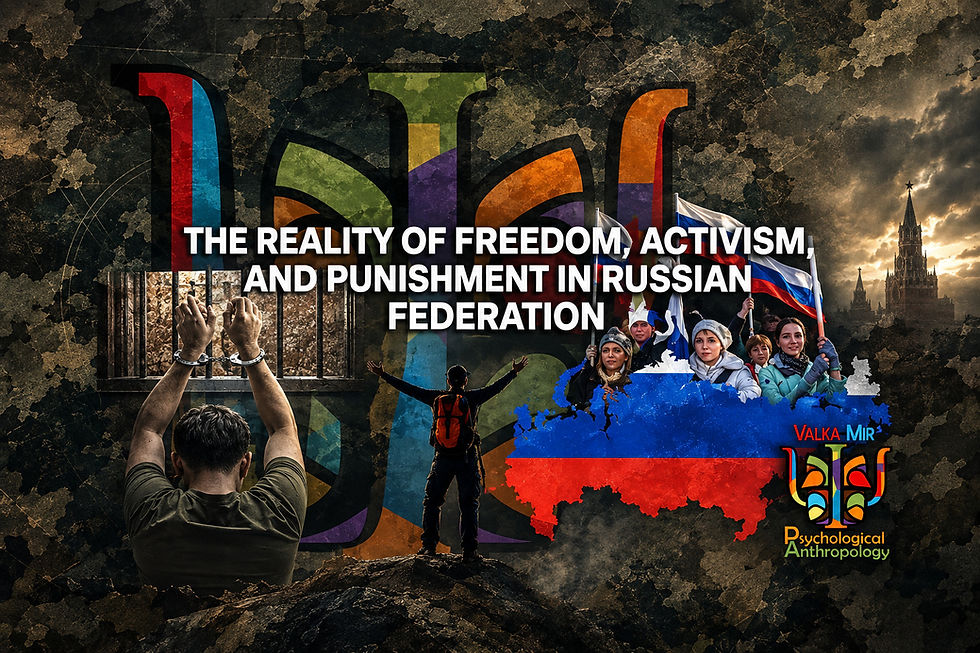
In the Russian Federation, the intersection of activism, freedom, and punishment is governed by a highly centralized, authoritarian state apparatus designed to suppress civil dissent, eliminate independent political expression, and enforce population compliance.
The Reality of Freedom: Constitutional Nullification and Judicial Subordination
While constitutional rights and freedoms are formally guaranteed under Russian law, they are effectively nullified in practice. The state operates under an authoritarian framework centered in the Kremlin rather than a functional "Rule of Law" system:
Subordinated Judiciary: The judicial system is fully subordinated to the executive branch and security services, offering no independent judicial review for politically motivated cases. Normal criminal courts handle everyday public order, but political protest, anti-war speech, and challenges to leadership are processed by specialized courts and the Federal Security Service (FSB).
Decimation of Independent Media & Digital Censorship: Virtually all independent media outlets and non-governmental organizations (NGOs) have been shut down, blocked, or forced into exile. State regulators, such as Roskomnadzor, block thousands of websites, restrict social platforms, and censor information contradicting official state narratives.
Transnational Repression: The state's reach extends beyond its physical borders. Security services engage in systematic surveillance and transnational harassment against critics in exile, frequently interrogating and threatening their family members remaining within Russia.
Activism and Dissent: Strict Prohibitions and Social Expulsion
Public activism in Russia carries severe legal, physical, and social consequences, effectively making collective protest illegal:
Bans on Demonstrations: Holding any public gathering or rally requires prior official permission, which is routinely denied for opposition movements. Rallies in support of opposition political figures or anti-war causes are met with immediate, violent police crackdowns.
The Suppressed "One-Person Picket": Technically, single-person demonstrations ("one-person pickets") remain legal under federal law; however, in practice, any individual attempting a solo picket is immediately detained and charged if their display violates censorship or anti-dissent statutes.
Societal Isolation and Resentment: Political dissidents face psychological and social ostracization. A significant segment of the population views political activists with a mixture of fear (that activism will cause social disruption and derail personal economic stability) and resentment. Dissidents note that Russian society actively "expels dissent from within," forcing critics into exile or breaking those who remain.
Censorship Laws and the Criminalization of Expression
Following the February 2022 invasion of Ukraine, the Russian parliament introduced broad war censorship laws that criminalize criticism of military actions or state policy:
Felony "Discreditation" & "Fake News" : Criticizing the invasion, calling the "special military operation" a "war," or spreading "deliberately false information" about the armed forces are treated as serious felonies carrying prison sentences of up to 15 years. In 2024, new legislation was introduced allowing the state to confiscate the property of individuals convicted under these censorship laws.
Persecution of Trivial and Symbolic Acts: Authorities aggressively prosecute subtle or symbolic acts of dissent, including:
Wearing blue-and-yellow shoes or clothing resembling the Ukrainian flag.
Dyeing hair blue-and-yellow or listening to Ukrainian music in public.
Displaying signs reading "No War", posters with eight asterisks (representing the eight letters of the Russian phrase Нет войне), or holding up a blank sheet of paper.
Posting photos online wearing a yellow coat against a blue sky (e.g., journalist Antonida Smolina).
Jailing veteran human rights figures, such as Oleg Orlov, for alleged "hatred of traditional values".
Financial Support as Treason: Sympathizing with Ukraine or donating money to Ukrainian humanitarian or military initiatives (such as United24) is classified as treason, exposing individuals to immediate arrest, severe torture, and long-term imprisonment.
Administrative Excommunication: "Foreign Agents" and "Undesirable" Labels
Beyond direct criminal charges, the state utilizes administrative designations to destroy the livelihoods of civil actors:
The "Foreign Agent" Register: Individuals or organizations that criticize government policy and are deemed to be under "foreign influence"—or who have received any money from abroad (even from a relative)—can be designated as "foreign agents" without a trial or criminal conviction.
Creation of Administrative "Non-Persons": Being labeled a "foreign agent" or an "undesirable organization" strips individuals of basic civil functions. Designated individuals are effectively rendered administrative "non-persons" who are barred from renting apartments, attending educational institutions, securing formal employment, or receiving state support.
Persecution of Legal Counsel: Practical access to legal defense has been severely eroded. Court-registered lawyers who represent political clients or dissidents are systematically targeted, investigated, and placed on wanted lists for allegedly aiding "extremist" organizations or enemies of the state.
The System of Punishment: Law Enforcement and Physical Abuse
The punitive apparatus is enforced locally and centrally through district police, FSB officers, military commissariats, and specialized bodies like the Centre for Countering Extremism.
Arbitrary Detention and Pretrial Abuse: Suspects detained for political activism or anti-war posts face harsh administrative fines, long penal colony sentences, and systematic physical abuse. Physical violence by police officers is widespread during initial detention and pretrial hold (SIZO).
Documented Torture: Human rights monitors and court filings document methods of torture used during interrogations to extract confessions or punish dissenters, including severe beatings with rubber batons, electric shocks to genitalia, asphyxiation using plastic bags, prolonged stress positions, and mock executions.
High-Profile Cases of Police Violence:
Aleksandra Kaluzhskikh: During anti-war crackdowns, her interrogation at Moscow's Brateyevo police station was surreptitiously recorded, capturing 11 minutes of continuous physical beatings, verbal abuse, and suffocation threats by police officers after she invoked her constitutional right against self-incrimination.
Vladimir Markov: After participating in protests, the former officer was abducted by police colleagues, severely beaten until he suffered a traumatic brain injury and fractured jaw, and threatened with further violence if he did not cease his online criticism.
Coercion to Military Service: In detention centers such as Moscow's SIZO-7 (Kapotnya), security forces have utilized physical torture and coercive pressure to force civilian detainees into signing military contracts.


Comments