

Ethnic, Cultural, & Family Social Conditions in Chad
Ethnic, Cultural, & Family Social Conditions in Chad.
In the constructed societies of the developed world (as in UK and Europe), we have systems of repair of body, mind, habitat, relationships, and even family-like support systems because we have an expectation of damage and disruption. This is why it’s called a constructed society rather than an inherited, sociocentric, tribal society. Constructed societies are repairable because they are expected to break. They break with job changes, education, travel, crime, elections, and so on. Sociocentric inherited societies are not expected to face such constant change, needing constant repair.
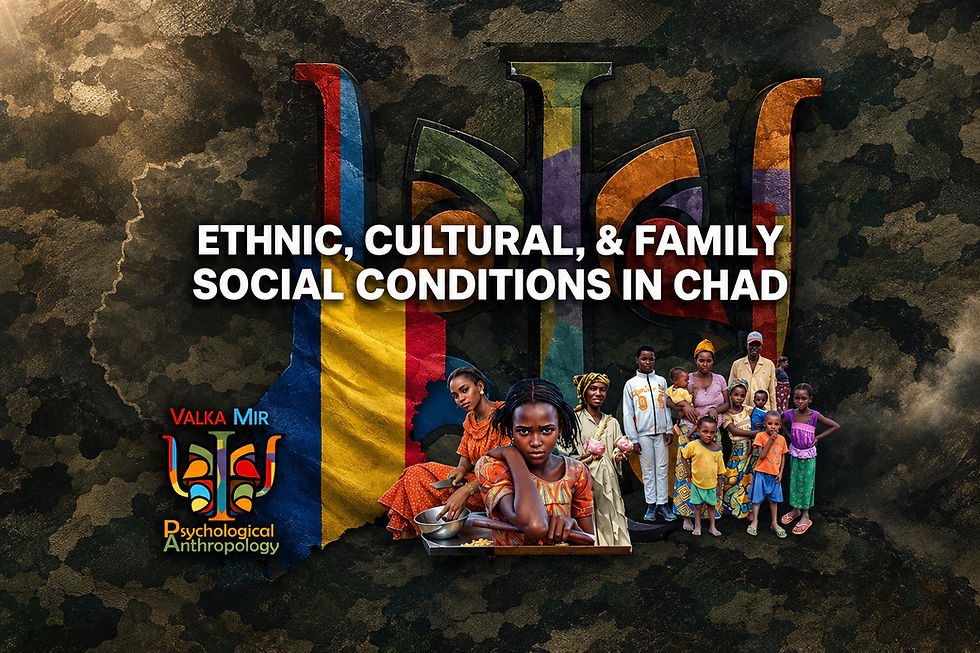
When damage happens to Chad’s tribal population segments, they adapt, they accept, the large extended family and tribe flexes around the damaged person(s) and the community copes. When the entire village is destroyed, when the family is lost, when war breaks these vulnerable inherited lifecycles, the survivors either survive or they don’t. There is no safety net. No medical assurance. No right to life or right to be free from fear. A person’s physical injuries will either sufficiently heal, or she/he will perish. A person’s psychological trauma will be endured because she/he will likely end up on the streets where the struggle for physical survival pushes effects of trauma deeper into the mind’s recesses. Over the last few years, thousands of displaced young people have fled to N’Djamena from the villages in rural Chad. They are driven out of their home villages by war, violence, drought, mining, desertification, and deforestation. If they are lucky, they find work in part-time jobs as domestic workers or street vendors. These young men and women, many of them minors, are given colloquial names by the wealthier residential neighbourhoods of
“God divided the jinn and the humans into ten parts. One part makes up the human race, and the other nine parts is made up of the jinn.” (El-Zein 2009, p.52)

N’Djamena. In one of the capital’s northern neighbourhoods, a 40-meter-wide boulevard runs through several wealthy neighbourhoods which attract homeless young people for subsistence work, who are called fonctionnaires de la rue de 40. The young women are usually hired by rich families in the city’s northern neighbourhoods, where they carry out menial tasks for the household in exchange for salaries far below the national minimum. They are often subjected to ill-treatment and sexual abuse. During the day, the young men roam the streets, offering various objects and services (nail clippers, shoe-shiners, hairdressers, domestic and everyday objects, pens, second-hand clothes, etc). They live together in small rooms in the outlying neighbourhoods of N’Djamena (especially Walia, Ngueli, Farcha and Gassi) and travel long distances to get to their workplaces. They can be seen in groups of five or six, morning and evening, walking along the streets leading to the neighbourhoods where they work. The collective psyche of N’Djamena’s wealthy and elite, views these young people with a mixture of pity and reproach, accusing them of the evils of which they are both the vectors and the first victims. In a country where references are still overwhelmingly linked to the rural context, they are associated with all the scourges of large urban centres: violence, addiction, robbery, incivility, low education levels, isolation, misery, ill-treatment, delinquency, precariousness, prostitution, sexual abuse, early pregnancies, HIV-AIDS and other STDs, exploitation, and even slavery. The way in which they are treated by their bosses, and the misery of their condition arouses compassion. Conversely, their lack of education and poor upbringing, the violence that is attributed to them and some of their behaviours, which are scandalous in the eyes of Chadian society, are met with disapproval. Deep down, they are blamed for having left the villages out of laziness, to escape the hard work in the fields, and to let themselves be taken in by the mirage of an easy life in the city. Associated with the rural exodus, this phenomenon which, according to N’Djamena residents, is growing in scale, is both shocking and worrying.

Comments