

Heroic Cultural Identities: Indigenous versus Eurocentric.
US Army Special Forces counterinsurgency efforts in South America were often oriented towards security services (military & police) reform to stop and change the patterns of human rights abuses and their engagement with civilian populations as though they were occupied territories. We found during our advisory and training missions in Panama, Guatemala, Peru, Ecuador, and Colombia that many, if not most, of the Latin American countries possess(ed) a culture within their security services of toxic paternal masculinity. Changing these toxic cultures was far more difficult a task than simply teaching the basic mechanics of military and or police operations. The growing levels of violence that the security services of Ecuador levelled against their own populations in vain attempts to dispel the rise of indigenous political activism over the past 40+ years has been matched by a rise in countering government violence by both violence and non-violent negotiation. Leonidas Iza, the indigenous leader of Ecuador’s Confederation of Indigenous Peoples (CONAIE), urges his formerly passive co-ethnic Quechuan communities to “resort to resistance… [because Lasso government was] putting in place more and more policies of death, which don’t allow us to sustain our small economies.”
Iza’s vision of resistance has been to defy government curfews and engage in direct action such as blocking roads, occupying the capital of Quito and its parliament buildings, and demanding an alternative form of society modelled after indigenous identity rather than that of Europe. Iza’s indigenous protesters have been blocking highways, and in some cases, puncturing the wheels of buses, forcing passengers to walk. In the protests of 2015, 2019, 2020, and 2022, Ecuador’s government followed a pattern of reaction, declaring a series of state emergencies and deployed its military security services with broad powers to participate in security operations at demonstrations and meetings, and to use lethal force.

The Quechuan communities of the Andean regions at the centre of resistance to the governments in Quito and Lima, have begun to re-emulate the aggressive confrontational stances of Ecuador and Peru’s security services by remembering and reactivating long sleeping heroic indigenous prototypes within their cultural identities. The principal story of the Quechua Incan people is brought to life in an amazing larger than life mural that details a major historical interruption of the Incan Nation by the Spanish invasion and colonization in the 15th – 18th Centuries. The image in figure 11 is one of a series of murals in Cusco, Peru that was painted by indigenous artist Juan Bravo in 1992. As you enter the city of Cusco, it is nearly impossible to miss this gigantic work of historical art that stretches hundreds of feet along the Avenida El Sol. The mural begins with the birth of the Inca civilization, where you can see the Incan god Viracocha who sends a man and a woman, Manco Capac and Mama Ocllo to start a civilization. Manco Capac was given a golden staff and was ordered to travel around. Wherever the staff sank firmly into the ground, they would start the Inca civilization. The golden staff sunk firmly in Cusco, and the civilization began in full swing.
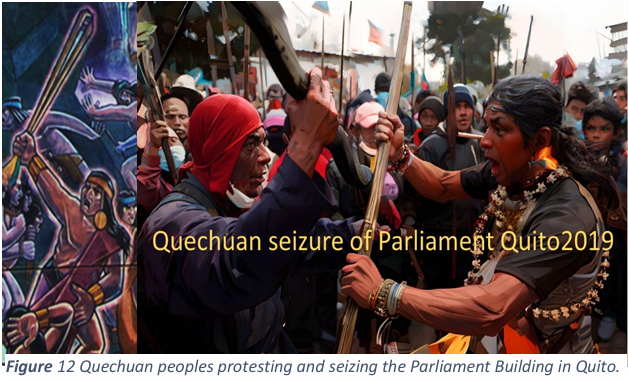
Much of the mural involves an emotional depiction of the brutal Spanish conquest and destruction of the Incan civilization. If you look closely at the humans in the mural and compare them with the Peruvian and Ecuadorian citizens of the Andean Mountain regions (see figure 12) where the capitals of Lima and Quito are located (respectively), you will notice a phenotypical commonality. Andean Mountain Range citizens share physical characteristics with the people portrayed in the Cusco Mural: Dark, smooth skin, straight jet-black hair, a similar pattern of facial features, and the use of colours, clothing type, and even mannerisms allow the viewer to discern that the population pictured in the gigantic mural are the same cultural identity group that still inhabits most of the highlands of these two countries. The current and future symbolic objects of political contestation and militant weaponization will almost certainly continue to be based on race, cultural origin, and a clash of social organization. The clash over psychological social organization will pit ethnic sociocentric-collectivist indigenous ideas of mutual obligation against European based egocentric-individual agency rights in a free market society. You can already imagine the symbolic objects that will become weaponized on both sides of that looming conflict. Against the backdrop of this growing contest between the Eurocentric Columbian world rooted in western chauvinism and the pre Columbian indigenous world rooted in Quechua Pacha, the plight of the dwindling criollo remnants of postcolonial inheritance is becoming untenable and dangerous.


Comments