

Trauma induced malformed individual & collective Russian identity
Trauma induced malformed individual & collective Russian identity.
Professor Gulnaz Sharafutdinova, describes this deformed personhood as “a double-thinking, suspicious and fearful conformist with no morality, an innate obedience to authority and no public demands.”
Traits associated with Homo sovieticus include indifference to work outcomes, lack of initiative, disregard for common property, chauvinism, obedience to government, and heavy drinking. The term marks the gap between these observed traits and the idealised “New Soviet man” promoted by the Soviet system. Historians and sociologists such as

Michel Heller and Yuri Levada similarly defined Homo sovieticus through qualities such as indifference, theft, lack of initiative, and submission to authority. Scholars continue to debate both the empirical basis of the concept and whether it remains useful in post-Soviet Russia. In this report, however, we use the concept as a way to understand the damaging effects of the USSR’s attempt to erase or overwrite hundreds of collective identities in favour of a broad Soviet personhood designed to facilitate population control across captive indigenous nations within an empire turned authoritarian federation. As a heuristic for the malformation of psychosocial identity across parts of the former Soviet Union, the concept cannot fully capture the consequences of this historical period.
On figure below nonetheless illustrates the predictable mental, emotional, and behavioural effects of prolonged violent trauma on individuals, families, and communities. The concepts shown in purple represent the internal mental and emotional dynamics of trauma, while the concepts shown in green represent the behavioural consequences.

If we compare these patterns with the descriptions of Homo sovieticus offered by Heller, Levada, and Sharafutdinova, the overlap is striking. Their pejorative depictions of Soviet and post-Soviet men and women correspond closely to the psychosocial symptoms associated with prolonged violent trauma and distorted social realities.
The lists shown above in Figure 4, offer a fuller representation of the sequelae of violent, prolonged, and complex psychosocial trauma of the kind experienced by generations living under the tsarist monarchy, the Soviet Union, and now the Russian Federation.
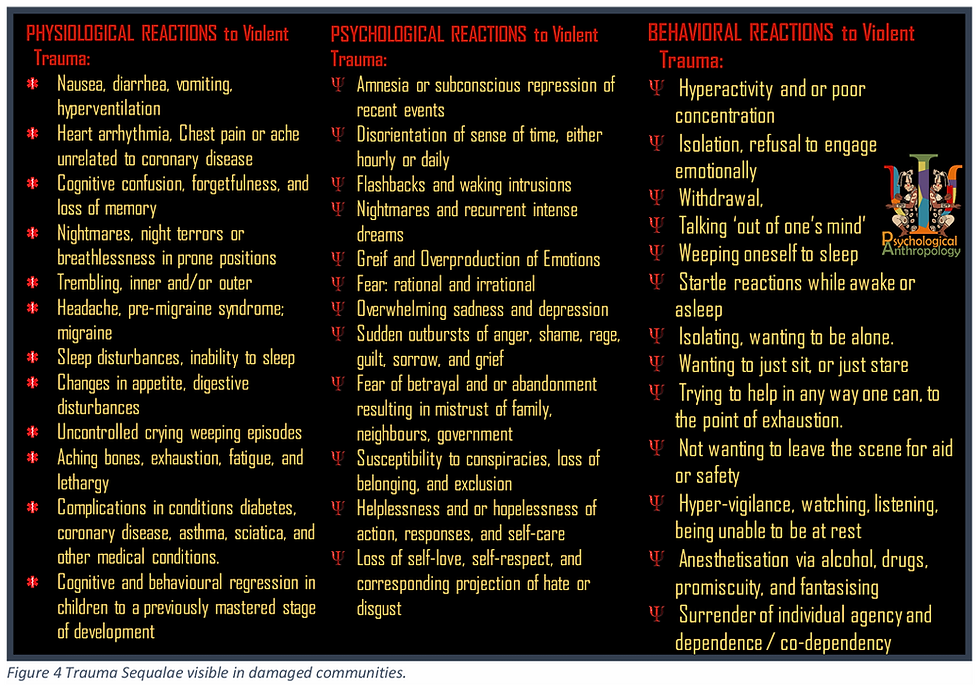
One objection often raised against the descriptions offered by Heller, Levada, and Sharafutdinova is that they describe observable behaviour without sufficient underlying context. Yet characteristics such as double-thinking, fearful conformity, moral disengagement, innate obedience to authority, lack of public demands, indifference to work results, lack of initiative, disregard for common property, chauvinism, obedience to government, and heavy drinking correlate with one or more of the trauma sequelae listed below. When the descriptions of Homo sovieticus are re-examined in light of known trauma symptomology, our interpretation of population behaviour changes. Equally important for this psychosocial profile is the relative predictability of these sequelae in populations shaped by repeated violence, deprivation, and identity disintegration under successive imperial, Soviet, and federal regimes. The aim is not to mischaracterise surviving populations of the former USSR, but to understand the damage done to their collective ethno cultural identities and to the psychosocial health of their communities, whether as independent states or as populations still subject to the Russian Federation.
These are the analytical lenses used in the remainder of this research to assess the threats posed to, and by, population segments within the Russian Federation, especially those in positions of authority who may exercise violent domestic control over others. In countries of origin where the rule of law is weak or applied primarily for the benefit of an authoritarian elite, the mental and emotional condition of the population segment charged with maintaining the state’s monopoly on violence has direct implications for the safety of those targeted by it. Elites in power may not always intend overkill or excessive punishment, but their overriding objective remains control over the population and its resources. All else is secondary. As you consider the physiological, psychological, and behavioural sequelae set out in Figures 4 & 11, consider that the population’s negative attributes are predictable outcomes of prolonged violent trauma. In our next report, examines the distribution of the federation’s population segments and resources, these psychological, physiological, and behavioural patterns will continue to inform the ongoing psychosocial pathologies in both rulers and ruled.


Comments