

Country of Origin Report: Russian Federation. Introduction to an Asynchronous Enforced Federation of Republics, Krais, and Oblasts.
Introduction to an Asynchronous Enforced Federation of Republics, Krais, and Oblasts.
The Russian Federation does not conform to the European Westphalian model of a bounded political state open to all legal citizens. Rather, it functions as an imperial formation that, by territorial scale, ranks among the largest in world history after the British and Mongol empires. Figure 1 provides an illustrative comparison of this imperial formation alongside the surrounding Westphalian states of Eurasia. Patterns of internal population movement and resource distribution within this federation-empire differ markedly from those that prevail across Europe and North America. These differences are central to understanding the psychosocial organisation of life across the 80 governing entities that constitute the contemporary federation. Without at least a basic understanding of these psychosocial conditions in the country of origin, it is difficult to assess human rights concerns, systems of crime and punishment, relocation, possibilities
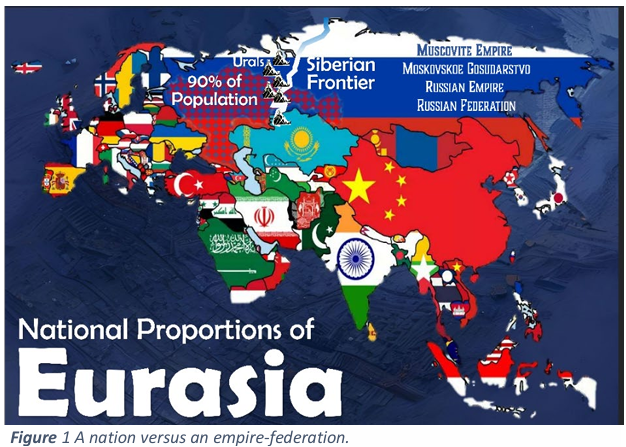
internal for and other asylum-related questions commonly raised by immigration tribunals. Most fundamentally, without such an understanding, it may be impossible to answer the basic question: who is Russian? Figure 1 A nation versus an empire-federation. Not all people in the Russian Federation identify as ethnically Russian. Interviews with individuals who identify as Ukrainian, Belarusian, Chechen, Ingush, Siberian, Tajik, Uzbek, and members of other ethnic and cultural communities make this clear. A central question, therefore, is whether these groups constitute vulnerable populations within the federation, and under what conditions. Russians have debated the nature and meaning of Russian identity for three centuries, both within territories governed from Moscow and beyond them, across imperial, Soviet, and federal periods. David Brandenberger has described Russian national identity as an “accidental creation,” while Alfred Evans and other scholars argue that post-Soviet Russia remains in the midst of an identity crisis captured by the question, “Who are we?” Because intellectuals, politicians, and social leaders inside and outside the federation offer competing answers, there is no clear agreement on who properly belongs under Kremlin rule and who is a member of a captive people through invasion, conquest, or coercion, whether today or in earlier periods. As a result, what might otherwise be a straightforward social-scientific task—describing civil life in a bounded state to identify protected or vulnerable populations under international law—is far more complex for the approximately 145 million people subject to Kremlin rule.
“I remember when I was a teenager, and I had to apply for an identity card. The person in charge asked me what ethnicity I was, and told me that if I don’t know, then they will make me Russian. I told them that no, I am a Crimean Tatar, not Russian! The man said that there was no such ethnicity and recorded me as being Tatar, which is completely different than what I am. I told them that I am Crimean, or Kirimly, but they didn’t care. “ - Vadym, 42-year-old refugee from Russia, living in Ukraine.
Without a clear framework, even specialists in psychology, sociology, and anthropology may struggle to assess the practical realities of internal relocation within the federation. For instance, can an ethnic Belarusian, Russian, Ukrainian, Karelian, or Komi survive in the oblasts, okrugs, or republics east of the Siberian frontier? Our research suggests that living conditions across the Russian Federation vary sharply at the level of basic survival. In Moscow and St. Petersburg, residents have access to indoor plumbing, toilets, electricity, gas heating, and commercially available food. Outside these major urban centres, these basic conditions may be absent, making survival much more difficult for people accustomed to metropolitan infrastructure. Interviews also suggest that individuals and families cannot simply move to Moscow without administrative approval. They require internal documents specifying where they may live and work, and whether they appear on lists of undesirable persons. In this sense, survival in the Russian Federation depends not only on location, but also on identity, place of origin, social belonging, and access to support networks.


Comments