

Life in the Russian Federation. Reality
Life in the Russian Federation.
In February of 2024, the American television personality Tucker Carlson, visited Moscow and reported on the city’s virtues as compared to the United States and Europe. One aspect of his reporting was about grocery or food supermarkets, and his visit to the flagship Azbuka Vkusa branch store next to the Ministry of Foreign Affairs in Moscow, accurately describing it as more luxurious than any grocery store within 100 miles of Washington, D.C. The Dispatch’s Jonah Goldberg retorted back to Carlson that “I don’t care what some flagship supermarket in an imperial city looks like. Russia is far, far poorer than our poorest state, Mississippi.”
Available reporting suggests that populations in Russia’s regional and capital cities have, at least until recently, lived at a material standard comparable in some respects to parts of Europe or the Americas.

Figure 12 shows that the greatest population densities lie west of the Siberian frontier, on the western side of the Urals. Outside these regional and capital centres, however, life is far harsher, with many areas
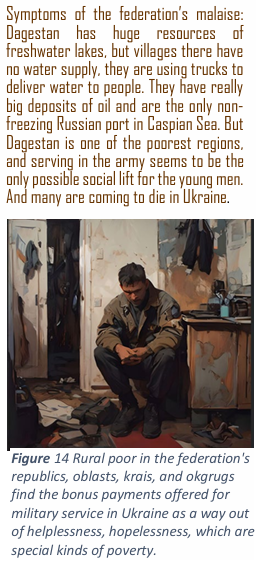
lacking plumbing, electrification, roads, and other basic infrastructure. Many Siberian republics, oblasts, okrugs, and krais remain in these conditions, even as the western capitals have modernised through the extraction of Siberia’s natural resources. These poorer republics have also become primary recruitment grounds for soldiers fighting in the Kremlin’s wars, which offers insight into conditions in the federation’s ethnic provinces. Captured rank-and-file soldiers interviewed by Ukrainian forces often describe lives marked by poor education, limited opportunity, and stark deprivation compared with urban life, access to which may require formal permission to relocate. In our research, we were surprised at the levels of rural Ukrainian villages that lacked indoor plumbing and reliable electricity.
Respondents described their own villages as having water systems connected to only a few homes, with most residents carrying water in buckets from communal street pumps. Even villages connected to the regional power grid often rely on outdated electrical networks that fail regularly, leaving them in darkness. Residents described to us that the main routes out of their existing condition are securing permission to move to a city or joining the armed forces as basic infantry, which requires the fewest qualifications. These interviews help explain the concentration of the population in large urban agglomerations that merge into one another. Areas with the lowest population density often coincide with the highest concentrations of natural resources, making extraction easier and limiting the need to displace large populations.
“In Russia, we idealize and seek sacred meaning in our suffering. Patriotic and Orthodox literature is full of such ideas: Russian people are martyrs and passion-bearers, the most patient and meek, protected by the Mother of God – but at the same time, as the Russian Orthodox Church tells us, they are enduring punishment for the sins committed during the seventy years of Soviet rule. Hence their religiosity, even ecstatic piety, and the growing influence of a clergy who preach repentance and humility. Russian society expels dissent from within, forcing dissidents out. It breaks those caught within it, uniting them in bitterness. This is how Russia resists political unrest, in spite of constant economic and cultural crises. This is what ensures that there will be no change or political reform.” - Political Dissident Maria Snegovaya.
There is now substantial uncertainty about how sanctions are affecting life in Moscow and St. Petersburg. The frigid deprivation associated with the Cold War has clearly receded; ordinary citizens are no longer living amid universally empty shops and the same level of overt ideological control. Yet much has also remained unchanged. State repression now rests more on authoritarian control of hierarchy and order than on explicit ideology, but the coercion used against those who attract official attention remains severe. Before the full-scale invasion of Ukraine, the most sensitive subjects in public speech were challenges to the regime’s control over its federal subjects and questions about the legitimacy of the regime and its rulers. Especially risky were criticisms of the wars in Chechnya, Georgia, Moldova, and Abkhazia, as well as scrutiny of President Vladimir Putin’s personal life and finances, or those of his inner circle. Other complaints were often tolerated.
In the major cities, central streets are (relatively) clean, historic buildings are restored, and newer structures have been built. Outside the city centres, however, vast districts of Soviet-era apartment blocks still dominate the landscape, built to draw labour from farms and outlying regions into the cities, as discussed in the report: "Introduction to an Asynchronous Enforced Federation of Republics, Krais, and Oblasts."
Across these post-Soviet urban spaces, including in Ukraine, older generations often tend toward passivity, while younger people more often orient themselves toward material success and visible upward mobility. All of this helps explain Putin’s durability at the polls, even before he consolidated control over the electoral machinery itself. Among the core questions of this profile, therefore, are whether the federation is a repressive state, how repressive it is, whether non-violent internal political challenges are a serious concern for the Kremlin, whether any safe civic space remains, and what forms of danger define daily life in these societies.


Comments